Pages

Showing posts with label video. Show all posts

Tuesday, May 8, 2012

It's Just As Tiring as Climbing: Weaving on a Backstrap Loom

In Guatemala, textiles are everywhere. Especially in the highlands, where I've spent nearly all my time, the majority of women still dress in traje (traditional clothing). Men generally dress in western clothing.  It's definitely common to see a woman dressed like a photo in National Geographic walking around with a guy wearing Levis, a tee-shirt, and a baseball cap.  I guess it's because there has been more pressure on men to assimilate into western culture in order to work, whereas the Guatemalan woman's domain has remained at home.
women in traje selling flowers on the stairs of san tomas church in chichicastenango
Anyway, each place has its own style of corte (skirt) and huipile (blouse). Many (most?) of these pieces are still woven and decorated by hand, and they're beautiful, intricate, and colorful. It's mesmerizing, especially for me, because I enjoy dabbling in fiber arts and have a wardrobe of mostly earth-tone, solid color, boring clothing (no blingy flourescent pink or sequins).

I love traveling because I love learning/ experiencing/ appreciating things that I can't really learn/ experience/ appreciate at home. One of the things I wanted to do in Guatemala was learn how women make these beautiful textiles. I hooked up with Trama Textiles, a cooperative of women tejedores (weavers) in Xela for a 10-hour crash course in using a backstrap loom for weaving.

It took about three hours of prep work before I could even start weaving, then about six hours to weave a simple six-foot scarf. And let me tell you, I am so glad that I have well-developed shoulder and back muscles from climbing big rocks, because my arms were tired by the end!

Here's how the entire process of weaving a scarf, from start to finish.  If the text and pictures don't make any sense, just skip to the video at the end!

Step 1: Select your colors, one main color (green) and two contrasting colors (white and gold).

Step 2: Put the skeins of thread onto two rotating arms (known as a devanadera) and wind two threads together into a ball (devanar, to wind).

Step 3: Make your design. In my case, I had 180 threads to divide into a pattern of stripes.

Step 4: Wind the threads around a warp board (urdidor). Looking down at the urdidor, start at the upper right, cross down the inside, wrap around the bottom, and cross up the outside to the upper left. From the upper left, cross down the inside, wrap around the bottom, and cross up the outside. This is warping, or urdir.

The number of threads of each color in your design corresponds to the number of wraps you make. You'll end up with a stack of threads crossed over each other at the top pegs of the urdidor, like this:

Step 5: Set up (armar) the loom (telar de cintura). Apparently this takes a while, and can be a bit difficult, so my teacher did it for me while I went to lunch.

The top loops of the thread are wrapped around two dowels. There is another dowel, called a pulito, that holds up half of the threads. Beneath the pulito there's another dowel called a laviadura, whose threads hold up the other half of the threads.

Step 6: Strap yourself into the loom by putting the belt (cintura, though I think there's another name for it) around your waist and wrapping its threads around the bottom of the loom.

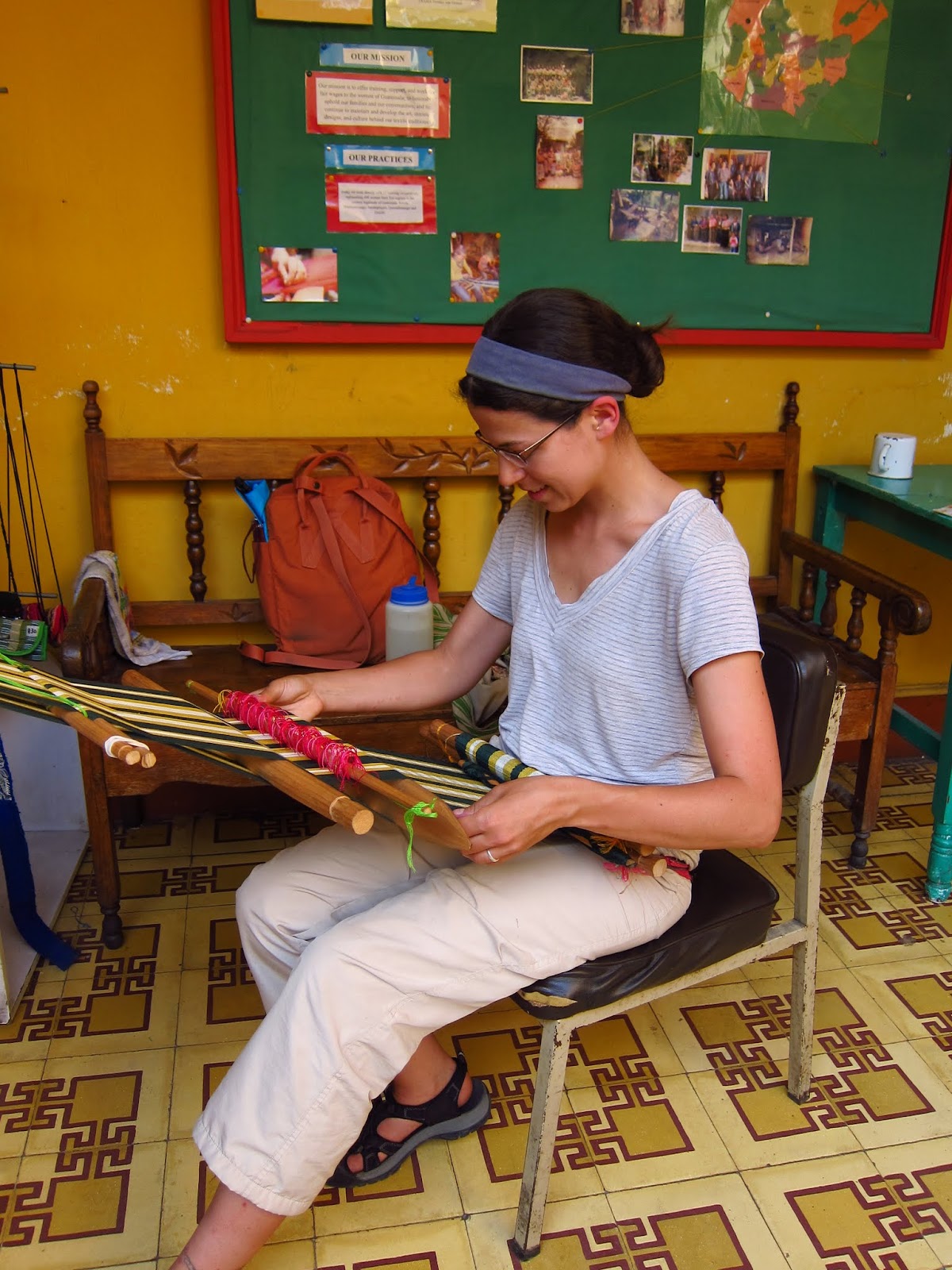
Step 7: Weave! ¡Teja! Weaving is divided into two processes, proceso uno and proceso dos.

Proceso uno:
Lift the laviadura, raising one half of the threads.

Insert the torpidor, an oblong piece of wood, under this half of the threads.

Pack down the threads already woven.

Rotate the torpidor, raising this half of the threads.

Pass the trama, a baton with thread wrapped around it, under this half of the threads. The thread on the baton becomes the weave threads (in contrast to the warp threads, which go lengthwise along the scarf).

Remove the torpidor.

Proceso dos
Slide together the laviadura and the pulito. This raises up the other half of the threads! Neat!

Insert the torpidor under the other half of the threads.

With the torpidor, pack down the thread that you just placed with the trama in proceso uno.

Rotate the torpidor to lift the other half of the threads.

Pass the trama under the other half of the threads.

Remove the torpidor. Start from the beginning of proceso uno again, using the laviadura to lift the first half of the threads!

If that didn't make any sense, here's what the sequence looks like when you put it all together:


Step 8: When you reach the end of the warp threads, cut the piece from the dowels and tie the lose ends in decorative knots.

All done!

Tuesday, March 20, 2012

Wee Stinky, Flower of Death

The big stinky flower of death bloomed at Cornell!


This "little" guy has a few names.  The Titan Arum, for us English speakers.  Amorphophallus titanum, for the science geeks.  And Wee Stinky (no, seriously), named for a small glen on Cornell's campus, for us locals.

The mad scientists up at Cornell grew this specimen from a seed produced by a plant in Wisconsin in 2002. Some people get dogs, which live about a decade...  other people grow rare Sumatran rainforest plants, which take a decade to bloom then flower for 48 hours.  Different strokes, different folks, etc.

Being Upstate NY (where not much of note ever happens), pretty much the entire town (ok fine one-third of the town) turned out to see Wee Stinky's Big Moment.  It was like Wegman's on Saturday morning, just as surreal and slightly more smelly.

Wee Stinky had the potential to be big, as some Titan Arum top 12 feet tall with a storage tuber weighing 200 lbs.  We visited Wee Stinky on its second day in existence, and I'd say it was about 7 feet tall.  I doubt Wee Stinky's tuber was 200 lbs, as Wee Stinky was living in a large plastic pot (like the kind you'd find at a big-box hardware store).

Wee Stinky's insides heat up to nearly 100F (98.6F, actually, same as our insides) in order to disperse the stank of death, hence the nickname "Corpse Flower."  By the time we met Wee Stinky, the stank of death wasn't so strong, more like a faint odor of fish rotting in the sun.  Indonesia's reputation for producing smelly things (durian, anyone?) disappoints again.

looking down wee stinky's insides--where the smell was the strongest
If Wee Stinky were in the Sumatran rain forest, its native environment, the stink would attract pollinating carrion flies.  Apparently Ithacans have more similarities to carrion flies than you'd think, because Wee Stinky attracted 10,000 humans during the two days it was in bloom.

That's right--Wee Stinky takes years to grow from seed, only to produce a bloom that lasts 48 hours, not to bloom again for decades.  I'm sure there's a metaphor in there somewhere, something about rotting fish and Sumatran rainforests, the ephemerality of time and gawking at all of nature's freak shows.  Something like that.

Cornell's College of Agriculture and Life Science took an amazing time-lapse video of Wee Stinky's moment of glory.  I can't get their direct link to work, so here's the video hosted at YouTube, but you should also go to the Cornell Titum Arum blog to show them some love.  One hundred percent of the credit for this goes to the awesome plant masters hiding in the greenhouses up the hill (what are they growing under those lights?).


Friday, December 24, 2010

Merry Christmas, from Bethlehem

I was talking to my Mummers on Skype a few weeks ago, just chatting about holiday plans and the usual.  In her usual motherly brilliance, she suddenly suggested that I visit Bethlehem for Christmas.

Nice idea, Mummers!

Since Christmas fell on a Saturday, and Saturday is the Jewish Sabbath, and Israel is a Jewish State, and therefore buses wouldn't run on Saturday, we took an Arab bus most of the way to Bethlehem (see below for details).

In a strange way, it felt great to be in Bethlehem.  It's an Arab village now, and it feels that way.  Thing is, I've gotten used to feeling like the "different" one wherever I go.  In Israel, I'm constantly mistaken for Israeli.  And I haven't been in a place so similar to the United States since leaving Australia.  Going to Bethlehem was like leaving "civilization" again, going back to a place where I'm the oddball.  This is normal to me now.

the mosque opposite Manger Square
When we got to Manger Square, there was a group of Latin American pilgrims playing "Hallelujah, Alegría," absolutely rocking out on guitars, drums, trumpets, whatever.  People were dancing in a circle, waving their arms in the air, and generally having a grand time.  It was a lot of fun!


The Church of the Nativity is nice.  Not the largest or grandest church I've visited, but probably the most crowded--it was PACKED with pilgrims.  A long line stretched from the back of the church all the way to the Grotto of the Nativity at the front of the church.  Somehow, Davo and I managed to get to the front of the line by going to the opposite side of the church, then getting waved through to cross the apse.  The actual spot where Baby Jesus was supposedly born is just a silver star on the ground.  You can see it on Wikipedia, if you're interested.

sooo crowded!
I've had a few people say to me, "Wow, to be in Bethlehem on Christmas...  I'm sure that must have been very moving, very spiritual."  Well, it felt like a big festival.  Everyone around me seemed quite happy.  But the atmosphere wasn't particularly spiritual.

christmas tree at manger square
The most touching moment of the trip was in the actual Grotto of the Nativity.  There were three or four monks down there.  One said, "Merry Christmas" to each and every person entering the grotto.  The others gently took each person's shoulders and moved them along, single-file.  One smiled and said quietly to me, "I'm sorry, the line is very long," as he moved me along.  I thought it was very touching that these monks were trying their best to make the experience special for each individual visitor, all 90,000 of us.  I guess I'm more interested in these simple, kind human touches in the present moment, rather than obsessing over legends from 2,000 years ago.


Merry Christmas!

For future reference, here's how to get from Jerusalem to Bethlehem.  You'll need 13 schekels for the round-trip fare.  Don't forget your passport.

Thursday, July 22, 2010

The Easiest Mountain I've Ever Climbed

Mt. Bromo:  hands down, the easiest mountain I've ever climbed.

Dave and I were planning our next move, and we realized that booking a package tour from Yogyakarta to Denpasar in Bali, with a stop in Bromo-Tengger-Semeru National Park, would be nearly as cheap as going independently.  Sigh.  So, we joined the tourist herd for 48 hours.  In retrospect, even though the mini-bus was cramped and the air-conditioning didn't work and the whole shebang was incredibly disorganized, it was probably better than the multiply public transport buses, mini-buses, and bemos we'd have to take.

We got up at 3:30 a.m. to catch a jeep up Mt. Penanjakan to see the sun rise from the north of the volcanoes.  The sunrise wasn't anything amazing, but holy guacamole, those are some pretty pretty mountains!!!

almost like looking at a painting

We piled back in the jeep and headed down into the "Sea of Sands," the inside of the massive crater from which rise the three volcanoes in the foreground above (Semeru, the tall mountain in the back, is outside the crater, to the south).


So, this is how I climbed the easiest mountain ever.  The jeep drops you off about 1-2 km from the mountain itself.  You walk across the sand, avoid the local Tengger people selling bottled water and horserides at the base of the mountain, then climb 253 steps to the top.  Yeah, there's a staircase.  But the crater at the top is pretty sweet!

holy smokes...  literally!

Here are the rest of the pictures from the day:


Here's what I'd do differently, if I visit again:

Sunday, July 18, 2010

Hypnotized by Wayang Kulit

I'm a very visual person.  If you tell me something, I won't remember it unless I see it written down.  I can take one glance at a map and find my way around a city for an entire day, but if I see written directions, I won't understand them unless I plot them on a map.  Dave taught me to drive a manual transmission vehicle by waving his hands in front of me to match the movement of his feet.

I think this is why wayang kulit, the Indonesian shadow puppet show, totally hypnotized me.  The puppets are beautiful--the leather is carved so some parts are thinner.  Then, the puppet is painted in vibrant colors with amazing detail, even though the puppets themselves aren't meant to be seen by the audience!  Luckily for me, we were permitted to walk around the stage and the gamelan orchestra providing the soundtrack.

How cool is this?!


So dramatic!  Here's what it looks like from the front...


Here are the rest of the pictures from our time in Yogyakarta...

Thursday, April 29, 2010

Let's Talk About Flax

Let's talk about flax.  This summer, we harvested and transplanted approximately 600 flax plants into the valley where we work.  What is flax, and why do we spend so much time working with it?

New Zealand flax is actually a member of the lily family (although parts of the plant can be used for making fiber, like European flax).  Flax has extremely long, sword-shaped, stiff leaves.  These leaves grow in a fan shape, and one plant growing from one root system can send out 8, 12, or even more fans.

This is New Zealand flax, complete with flower stalks with seeds.

In the spring, the flowers of the flax are an important source of nectar for birds, as they are too deep for bees.  In fact, the flowers of the flax plant curve at the same angle as the beaks of the tui birds!  In the summer, the flax sets its seeds, which are also an important food source for birds.  It's also a great shelter for birds, snails, and other insects.  (Remember, NZ does not have native land mammals, so birds are an extremely important part of the ecosystem here.)  Flax roots do a great job of penetrating very hard soils full of clay; their roots also do a great job stabilizing erosion-prone soil.

Flax has been used for many purposes by traditional Maori society.  Known as harakeke in Maori, flax fiber has been used to make clothing, ropes, canoe lashings--even baby rattles!  Nearly every part of the flax plant also has medicinal uses.  The leaves and flower stalks are used to stabilize and treat broken bones and other wounds.  A juice made from flax root is also a great disinfectant.

In this little video, Dave talks about flax and why it's important in New Zealand ecology.


Harvesting flax is a very dirty, very tiring job.  We work in pairs; one person uses a spade to dig around the fan of flax leaves and to separate the roots of the fan from the rest of the plant, while the other person grasps the fan by the outer leaves and tugs and pulls until it comes free.  We aim to harvest 200 plants every time we go into the field; this week, it took us only 2.5 hours to gather 181 plants (practice does help!).

If we're not going to replant immediately, we dump the flax in the river so it doesn't dry out.  Then we have to pull all of it out of the river and throw it back on the trailer.  (We usually make Dave do that part.)  Planting is simple--yank out the grass, dig a hole, pop in a plant, tap down the soil, use the grass as mulch around the bare soil.  Planting in wetlands is muddy and sloppy; once you get past the dirtiness, it's actually fun.

Here's a series of portraits from our last time harvesting flax:


...complete with lucky spade!  Yeah, we're having fun!

To get the flax from the bush to the trailer, we set up a fire line and toss each plant from person to person:


Unfortunately, I don't have any pictures from planting.  Imagine a spade and lots of dirt and you'll get the picture.

Yeah flax!

Wednesday, April 14, 2010

Summer 2010 Slideshow

Over the past few days, I put together a little compilation of the best photos from the summer 2010 earthwise valley residential conservation volunteer program.

It's 50% pictures, 10% captions, and 100% feel-good cheesiness.  Bring on the crackers and wine; you're in for a show!

Wednesday, April 7, 2010

Tongariro: Part IV

Laura, one of the women who lives and works here, made an awesome video of the sunset and moon rising that we enjoyed on our first night at the feet of Ngauruhoe.

Totally awesome video set to a really sweet song...  great work, Laura!  Enjoy!

Friday, March 19, 2010

Coromandel Roads (Subtitle: Motion Sickness)

The Coromandel Peninsula is very rural, and part of that rural character is its unpaved roads, potholes, and one lane bridges (just like being back in Ithaca, minus the snow).  Of the roads leading to Tuateawa, the road from Thames to Coromandel is paved, and the road through the hills across the peninsula from Coromandel to Tuateawa is unpaved and incredibly winding.

Here’s the topography of the peninsula:

View Larger Map

Google Maps doesn’t even show the road between Coromandel and Tuateawa:

View Larger Map

As we were driving the other day, I took some video out the window of our rickety old Toyota van.  Hold on to yer hats (and yer stomachs)…  we’re going for a ride.  You might want earplugs.


Enjoy the quail jumping out of the way?  Not feeling the motion sickness yet?  Here’s another short clip, where you can get a sense of how narrow the roads are as the hillside nearly takes out my camera.


As a note for my Yankee friends and family, Kiwis drive on the left side of the road.  Kiwi vehicles have the driver’s seat on the right and the passenger’s seat on the left.  I’m sitting behind the passenger seat to take these videos.

Tuesday, March 16, 2010

Mt. Moehau: Traverse, Then Traverse More

On Tuesday, we took a trip up to the far northern part of the peninsula with the intention of climbing Mt. Moehau, the highest point on the peninsula.


When we got to Stony Bay, we found out that the track was closed, but the woman tending the campground had some other suggestions for us.  We headed through a grove of large trees and into the forest to wander for a while.

Laura stands on the downed trunk of a huge tree, with more huge trees in the background.

We ended up on a trail next to a creek, traveling upstream for a while, until we crossed the creek and headed across a ridge. 

into the woods...

We traversed, then traversed some more, then kept traversing across this ridge.  At some point we realized we were going nowhere, and slow, but it didn’t matter: I was there to be in the forest and to be moving, not to get anywhere.  Journey, not destination.

Along the way, I saw my first wetas.  They were dead, but they were still pretty interesting!

Saturday, March 13, 2010

NZ Conservation Ecology & Really Old Trees

We recently took our first nature walk as a group since I arrived.  I really enjoyed tramping around in the woods.  Our program administrator, Ogre Jon, knows a lot about New Zealand forests, which means I get to learn a lot when I’m tramping with him.  For example, we spent a while discussing the landscape around us.  Here he discusses the reasons why we are working to restore native plant species in the valley below:


We went way off the track for the majority of the walk, so I got plenty of exercise climbing and twisting under, over, and around everything in my path.


The highlight of the walk was our end destination:  a 1,300 year old kauri in the back of the valley behind our land.


One thousand, three hundred years old!!!


Here are more pictures from the day.  The album is fairly small, because I left out all of the pictures I took of particular plant species (not terribly interesting).

Thursday, March 11, 2010

Whanake and The Trig

On Thursday, our free day, Dave and I decided to take a little nature walk up the ridge across from the front of the house.  The map on our wall labels it "Whanake," and says it has an elevation of 305 meters (1,000 feet).

We almost couldn't find the trailhead, but a friendly gentleman on a bike showed us the path and told us it would lead us to "The Trig."  What's a Trig?!?  I enjoyed a silly adventure looking for The Trig, as well as some beautiful views and interesting learning opportunities about the New Zealand forest.  Dave has been in NZ far longer than me, so he was able to show me some interesting aspects I wouldn't have noticed.

How about spider webs so strong they can catch fish?

Or a tree that has a very unique defense against parasitic plants?

Or how about a creature that started its life around the time Lief Eriksson landed in North America, 1000 years ago?

Finally, here are some photos from the day:

Enjoy!

House Tour

Thursday was a free day, so I had plenty of time to play around on the computer, including uploading photos and making a video tour of my temporary home here in Tuateawa.

Welcome home!

Friday, March 5, 2010

Good Morning, Sun

One of the residents here has a background in marketing and media, and she's been taking a lot of photographs and video of life in the Valley.  One morning last week, we had to wake up before the sun to take care of some issues on the land.  She took the opportunity to create a time-lapse video of the sunrise over the water from our deck.  This is 20 minutes of video condensed into 30 seconds.

The birth of a new day.  Enjoy each one.