Pages

Showing posts with label ecology. Show all posts

Tuesday, March 20, 2012

Wee Stinky, Flower of Death

The big stinky flower of death bloomed at Cornell!


This "little" guy has a few names.  The Titan Arum, for us English speakers.  Amorphophallus titanum, for the science geeks.  And Wee Stinky (no, seriously), named for a small glen on Cornell's campus, for us locals.

The mad scientists up at Cornell grew this specimen from a seed produced by a plant in Wisconsin in 2002. Some people get dogs, which live about a decade...  other people grow rare Sumatran rainforest plants, which take a decade to bloom then flower for 48 hours.  Different strokes, different folks, etc.

Being Upstate NY (where not much of note ever happens), pretty much the entire town (ok fine one-third of the town) turned out to see Wee Stinky's Big Moment.  It was like Wegman's on Saturday morning, just as surreal and slightly more smelly.

Wee Stinky had the potential to be big, as some Titan Arum top 12 feet tall with a storage tuber weighing 200 lbs.  We visited Wee Stinky on its second day in existence, and I'd say it was about 7 feet tall.  I doubt Wee Stinky's tuber was 200 lbs, as Wee Stinky was living in a large plastic pot (like the kind you'd find at a big-box hardware store).

Wee Stinky's insides heat up to nearly 100F (98.6F, actually, same as our insides) in order to disperse the stank of death, hence the nickname "Corpse Flower."  By the time we met Wee Stinky, the stank of death wasn't so strong, more like a faint odor of fish rotting in the sun.  Indonesia's reputation for producing smelly things (durian, anyone?) disappoints again.

looking down wee stinky's insides--where the smell was the strongest
If Wee Stinky were in the Sumatran rain forest, its native environment, the stink would attract pollinating carrion flies.  Apparently Ithacans have more similarities to carrion flies than you'd think, because Wee Stinky attracted 10,000 humans during the two days it was in bloom.

That's right--Wee Stinky takes years to grow from seed, only to produce a bloom that lasts 48 hours, not to bloom again for decades.  I'm sure there's a metaphor in there somewhere, something about rotting fish and Sumatran rainforests, the ephemerality of time and gawking at all of nature's freak shows.  Something like that.

Cornell's College of Agriculture and Life Science took an amazing time-lapse video of Wee Stinky's moment of glory.  I can't get their direct link to work, so here's the video hosted at YouTube, but you should also go to the Cornell Titum Arum blog to show them some love.  One hundred percent of the credit for this goes to the awesome plant masters hiding in the greenhouses up the hill (what are they growing under those lights?).


Friday, August 20, 2010

Malaysia? What's in Malaysia?

Written September 22, 2010

I'll be honest:  the reason I ended up in Malaysia was because of a cheap flight.  Denpasar, Bali to Kuala Lumpur for about 100 greenbacks.  I needed to leave before my visa ran out, so I figured, "Why not?"

Malaysia was an interesting place.  Just like Singapore is the most un-Southeast Asian city in Southeast Asia, Malaysia is the most un-Southeast Asian country in Southeast Asia.

The standard of living is quite high; Wikipedia tells me that the per capita GDP is roughly USD$14,800, the only country in SE Asia to beat the global average of USD$10,500 (except Brunei, which beats even the United States).  And you can tell it's wealthy, too.  The public transit is clean, efficient, and relatively expensive.  People are well-educated; most speak at least two languages, as English is a compulsory subject in schools.  While I did see some people living on the streets in Kuala Lumpur, the city felt just as modern and clean as Singapore.

Malaysians are an interesting ethnic blend of Malay, Chinese, and Indian.  So even though Malaysia is an Islamic country, defined as such by the Malaysian constitution, there are significant minorities of Buddhists (~19%), Christians (~9%), and Hindus (~6%).  We were in Malaysia for the start of Ramadan, but it didn't affect our travel plans at all.  We simply ate in Indian or Chinese restaurants for breakfast and lunch.

We spent our time in three places:  Kuala Lumpur, Taman Negara National Park, and the Cameron Highlands.

Sunday, May 2, 2010

Apartments for Bugs

On the scale of bizarreness from "common housefly" to "outlandish freak of your nightmares," the puriri moth sits somewhere around "imaginative Hollywood creation."  It's the largest moth in New Zealand, with wingspans up to 15 cm/ 6 inches.  Basically, it's the size of a small bird!  Strangely, this gentle giant only lives 2 days.  Its mouth parts don't work, so it doesn't eat.  It lives in its adult stage just long enough to breed.

adult female puriri moth.  photo credit:  Tony Wills, 2007

Even though the adult form of the puriri moth lives for only two days, the caterpillar form can live for up to 5 or 6 years.  The grubs gnaw their way into a tree and form a little burrow where they will sit.  And sit.  And sit.

checking out burrows--occupied and formerly occupied--in a kohekohe tree.  it's like an apartment complex for grubs!

close-up of an occupied burrow in a putaputaweta tree in our backyard.  there's a puriri moth grub waiting in there!

close-up of an unoccupied burrow in a putaputaweta.  the grub has emerged as a moth, but the hole in the tree remains...

eventually, the tree forms a scar over the burrow.

Recently, a scientist caught on camera for the very first time a puriri moth hatching out of its chrysalis.  It's awesome to see its wings unfurling.  The footage is here.  I definitely recommend that you take a look!

Pigs Do Fly

This is the laziest bird I've ever encountered:

"i'm not moving.  you can't make me move."

It's a wood pigeon.  He was hanging out in a cabbage tree in our front yard.  I walked within 8 meters/ 25 feet of him and took a picture of him; he looked at me.  I walked within 5 meters/ 15 feet of him; he ate a few more berries.  I walked right up under the cabbage tree; he turned his rear end toward me.  I extended my hand and took a picture.

He pooped.

Fortunately he missed, but I was again surprised by how placid and nonchalant most New Zealand birds seem to be.  This is what millions of years of evolution without humans, much less any other land mammals, will produce.

"how do i look from this angle?"

Wood pigeons, or kereru in Maori, is beautifully colored in gem-tones of emerald, amethyst, ruby, and sapphire, with a cream white belly and a perfectly round, sunset-colored eye.  Very pretty.  They're quite large, and they seem like they'd be dense and heavy and very nice to hold in your lap, like a cat.  When they jump off a branch to fly, usually the branch moves and they do not, not until they flap their wings hard to keep their large bodies afloat.

But I'm not writing about kereru because they're cute, fat birdies, even though I do like me some cartoonishly adorable, chubby birds.

"and how about this?"


Thursday, April 29, 2010

Let's Talk About Flax

Let's talk about flax.  This summer, we harvested and transplanted approximately 600 flax plants into the valley where we work.  What is flax, and why do we spend so much time working with it?

New Zealand flax is actually a member of the lily family (although parts of the plant can be used for making fiber, like European flax).  Flax has extremely long, sword-shaped, stiff leaves.  These leaves grow in a fan shape, and one plant growing from one root system can send out 8, 12, or even more fans.

This is New Zealand flax, complete with flower stalks with seeds.

In the spring, the flowers of the flax are an important source of nectar for birds, as they are too deep for bees.  In fact, the flowers of the flax plant curve at the same angle as the beaks of the tui birds!  In the summer, the flax sets its seeds, which are also an important food source for birds.  It's also a great shelter for birds, snails, and other insects.  (Remember, NZ does not have native land mammals, so birds are an extremely important part of the ecosystem here.)  Flax roots do a great job of penetrating very hard soils full of clay; their roots also do a great job stabilizing erosion-prone soil.

Flax has been used for many purposes by traditional Maori society.  Known as harakeke in Maori, flax fiber has been used to make clothing, ropes, canoe lashings--even baby rattles!  Nearly every part of the flax plant also has medicinal uses.  The leaves and flower stalks are used to stabilize and treat broken bones and other wounds.  A juice made from flax root is also a great disinfectant.

In this little video, Dave talks about flax and why it's important in New Zealand ecology.


Harvesting flax is a very dirty, very tiring job.  We work in pairs; one person uses a spade to dig around the fan of flax leaves and to separate the roots of the fan from the rest of the plant, while the other person grasps the fan by the outer leaves and tugs and pulls until it comes free.  We aim to harvest 200 plants every time we go into the field; this week, it took us only 2.5 hours to gather 181 plants (practice does help!).

If we're not going to replant immediately, we dump the flax in the river so it doesn't dry out.  Then we have to pull all of it out of the river and throw it back on the trailer.  (We usually make Dave do that part.)  Planting is simple--yank out the grass, dig a hole, pop in a plant, tap down the soil, use the grass as mulch around the bare soil.  Planting in wetlands is muddy and sloppy; once you get past the dirtiness, it's actually fun.

Here's a series of portraits from our last time harvesting flax:


...complete with lucky spade!  Yeah, we're having fun!

To get the flax from the bush to the trailer, we set up a fire line and toss each plant from person to person:


Unfortunately, I don't have any pictures from planting.  Imagine a spade and lots of dirt and you'll get the picture.

Yeah flax!

Wednesday, April 28, 2010

River of Ice


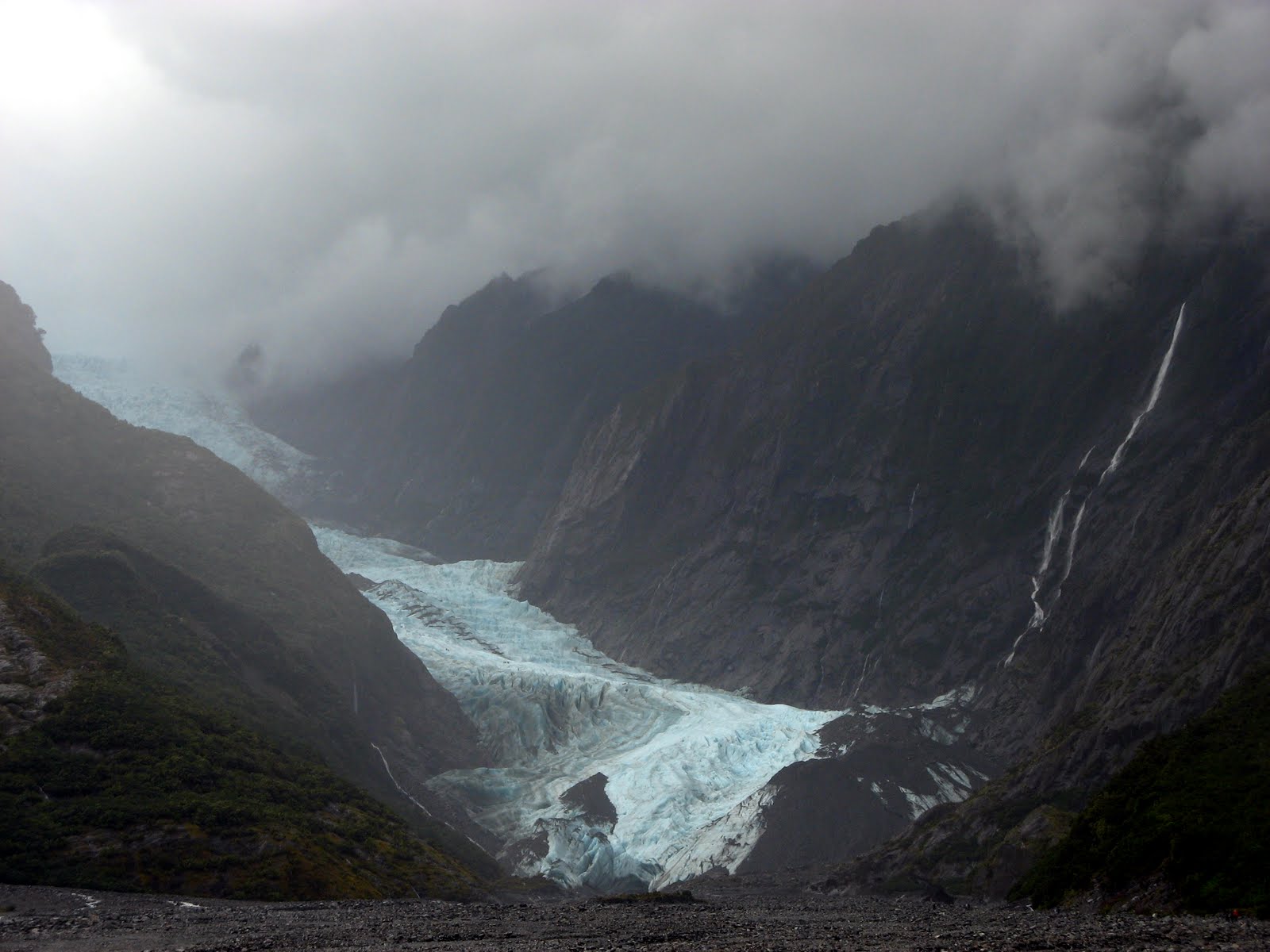
On our way down the west coast of the South Island, Dave and I stopped at the Franz Josef and Fox Glaciers.  Our hiking plans were completely thwarted by the torrential rains that had hit the area just a few days before our arrival.

That's a lot of water going under that bridge...

We did manage a quick walk up the glacial valley to the Franz Josef Glacier.

Waterfalls to rival Ithaca's cascade down the walls of the valley

Glaciers are rivers of ice...  literally.  Meters upon meters of snow will fall on the top of a steep mountain.  The weight of the constant snowfall compresses itself into sheets of ice.  The weight of the denser ice then slowly starts to slip down the mountain.  As the ice moves, it carves out grooves in the side of the mountain.  Viola!  A glacier and a glacial valley!

The massive Franz Josef glacier

Glaciers advance and retreat, meaning they move forward, away from their source (the “neve”), or backward, toward their source.  When the rate of glacier creation—snowfall in the neve—is greater than the rate that the glaciers are melting and breaking apart at their terminus, then the glacier advances.  Most glaciers around the world are retreating, but the glaciers on the west coast of the South Island are advancing.

water in three phases:  cloud, river, ice

The Franz Josef and Fox glaciers are unique because they travel from the highest mountains in the country—over 3,000 meters—to the coastal rainforest in a span of only a few kilometers.  Dave and I slept next to a beach, but we visited the Franz Josef glacier before lunch.  These glaciers also move much faster than the average glacier.  A heavy snowfall in the neve will produce an advancing glacier in about five years.  The glacier can move up to a meter a day.

the only picture in which one or both of us is not sticking out a tongue, crossing eyes, or making goblin faces

So, that's all you ever wanted to know about glaciers.  Another spectacular phenomenon of our beautiful world!

Monday, April 26, 2010

Moving South...

From Taranaki, we headed south to Wellington, the capital city of New Zealand.  I'm not much for big cities, and neither is Dave, so we spent only one day in Wellington.  Most of our time was spent at Te Papa Tongarewa, the National Museum.  It's one of the best museums I've ever visited.  I really enjoyed the exhibits on the geology and natural history of New Zealand.

Here are some pictures from our time in Wellington and Te Papa:


After Wellington, we took the Bluebridge ferry across the Cook Straight.  The voyage was very "meh," but the two ferry companies try to make it sound more exciting than it actually is.  It was pretty expensive to bring the van across, but since it's our transportation and our home, it was worth it.  Here are some pictures from the Cook Straight:

Tuesday, April 6, 2010

Kiwi House

On the way home from Tongariro, we stopped at the Otorohanga Kiwi House to view live kiwis and other native New Zealand bird and animal species.


They keep their kiwi birds in little habitats, and they allow visitors to view their feeding times.  We arrived just in time for the kiwis' 1:30 p.m. meal.  Since kiwis are nocturnal, they keep the habitat light during the night to simulate day, and then put on very dim lights for a few hours during the day to simulate moonlight.

Kiwis are the most ridiculous birds.  First, they can't fly.  They look like little wingless dumplings.  They have incredibly strong legs and feet, which they use for digging, scratching, and fighting.  Instead of a reasonable beak shaped like a hook or a bill or maybe a triangular cone, they have two chopsticks stuck into the front of their faces.  Even stranger, they have little nostrils at the end of their bills, instead of at the top near their faces.  They use their chopstick bills to probe into the leaf litter, snuffling around for insects and worms.

Stuffed (dead) kiwi bird from the visitors' center...  the kiwi house didn't allow photography of their kiwis.

And how do they move?  Let me share a brief, ridiculous example.  You can't make this stuff up.


In addition to the kiwis, the place had numerous other species, the majority of which were birds (New Zealand doesn't have any native land animals).

Putangitangi, the sheldrake duck.  This little guy was wandering around like he owned the place.

The pukeko, another of New Zealand's ridiculous flightless birds.

The kaka parrot.  We have a flock of kaka living in the forest next to our house in Tuateawa.  They have a very distinctive, croaking scream.

There were also a few tuatara and some geckos and skinks.  Even though the tuatara looks like a lizard, it's actually a completely different type of animal, from the order Sphenodontia.  In fact, the two species of tuatara are the only surviving members of this order, which flourished at the time of the dinosaurs!

I'm very special.  Also, my eyes look evil.

On the one hand, I was really happy that we stopped at the kiwi house.  I'm sure I never would have encountered a kiwi in the wild, much less a tuatara or some of the rare ducks.  I think that establishments like the kiwi house help foster an attachment to rare animals that you can't get without actually being in the presence of something incredibly alive and incredibly rare.

Having said that, the less rare but far more memorable, sexy, and flashy kiwi birds generated considerably more interest in the American, German, and Kiwi tourists than some of the far more rare ducks and birds elsewhere in the exhibit.  Is this just another tourist trap, albeit in a feel-good form?

Also, I was unclear of the origins of the animals.  I think (or I would like to believe) that all of them live in captivity because they can't survive in the wild, for whatever reason.  Still, it makes me a little sick to my stomach to see wild animals in cages.

I took this picture of a harrier through the mesh of his enclosure.


I went to take another picture, and my camera auto-focused on the bars.


How appropriate?

Tuesday, March 30, 2010

Reading a Landscape: Part I

My introduction to reading a landscape was the book, Reading the Forested Landscape:  A Natural History of New England, which I borrowed from Cornell Outdoor Education’s library (thanks, COE!).  This book showed how to recognize the signs of both natural events, such as blow down and beaver activity, and human actions, such as logging and pasturing, based on telling signs.

On our first nature walk as a group, we talked through one of the landscapes in our own backyard.


What can we see and learn from this forest vista?

The bluffs and ridges all around the Coromandel were formed by volcanic activity.  This is interesting to me, because many of the hills here remind me of the hills around Ithaca, which were formed via glacial activity, and the ridges here remind me of the Adirondack High Peaks, which were formed via tectonic movements.

You can see from the picture that different trees grow on the ridgelines compared to the sides of the ridges.  In this landscape, kauri and celery pine grow on the ridges, while kanuka grows on the hillsides.

Different trees fill different ecological niches.  The ridgelines are exposed to more light, but also are exposed to more wind and have poorer quality, more acidic soils.  Overall, there is probably less competition between plant species on the ridges than the hillsides.  On the protected hillsides, the soil is a higher quality, and opportunistic species have filled the valleys.

The trees on these hillsides are relatively small, indicating that the forest is young and still early in its process of succession.  When you are walking through the forest on these hillsides, there is a lot of smaller trees, densely packed.  There was definitely human disturbance which wiped out the old growth forest that preceded this relatively young forest.

Unfortunately, I’m not nearly as good at reading a landscape as I would like to be.  Even more unfortunately, I think reading a landscape is a dead or dying art.  I hope this series of posts will be a small stand against that trend.

Saturday, March 13, 2010

NZ Conservation Ecology & Really Old Trees

We recently took our first nature walk as a group since I arrived.  I really enjoyed tramping around in the woods.  Our program administrator, Ogre Jon, knows a lot about New Zealand forests, which means I get to learn a lot when I’m tramping with him.  For example, we spent a while discussing the landscape around us.  Here he discusses the reasons why we are working to restore native plant species in the valley below:


We went way off the track for the majority of the walk, so I got plenty of exercise climbing and twisting under, over, and around everything in my path.


The highlight of the walk was our end destination:  a 1,300 year old kauri in the back of the valley behind our land.


One thousand, three hundred years old!!!


Here are more pictures from the day.  The album is fairly small, because I left out all of the pictures I took of particular plant species (not terribly interesting).

Thursday, March 11, 2010

Whanake and The Trig

On Thursday, our free day, Dave and I decided to take a little nature walk up the ridge across from the front of the house.  The map on our wall labels it "Whanake," and says it has an elevation of 305 meters (1,000 feet).

We almost couldn't find the trailhead, but a friendly gentleman on a bike showed us the path and told us it would lead us to "The Trig."  What's a Trig?!?  I enjoyed a silly adventure looking for The Trig, as well as some beautiful views and interesting learning opportunities about the New Zealand forest.  Dave has been in NZ far longer than me, so he was able to show me some interesting aspects I wouldn't have noticed.

How about spider webs so strong they can catch fish?

Or a tree that has a very unique defense against parasitic plants?

Or how about a creature that started its life around the time Lief Eriksson landed in North America, 1000 years ago?

Finally, here are some photos from the day:

Enjoy!

Monday, February 1, 2010

What Makes New Zealand So Special?

I've been excited about visiting New Zealand since I was in high school and the first Lord of the Rings movies were released.  I was captivated by the amazing scenery, and I enjoyed watching the documentaries about filming the movie in NZ as much as I enjoyed the movies themselves.

Mt. Ngauruhoe, inspiration for film version of Mt. Doom, photo by Don Swanson, 1984

Since I made the decision to go to New Zealand, I've tried to learn a little about the land and its native species.  I've lived my entire life in New York and New Jersey in the United States.  My frame of reference, my concept of "outside," is a forest of oak and pine or maple and beech, or a gorge lined with hemlock.  I expect to see grey squirrels in the oak trees, white-tailed deer wandering through the pines, and blue jays zooming through the canopy (or terrorizing the chickadees).

New Zealand is completely different (not surprisingly--it is on the other side of the globe).  What is surprising are the extent to which and the reasons why it is unique.

Coromandel rainforest, photo by James Shook, 2005

Click the link below for more about New Zealand's otherworldly ecology!

Saturday, November 28, 2009

Why I Travel

Most Frequent Responses to
"I'm Quitting My Job and Traveling Around the World"
(In Order of Frequency)
  1. Wow.
  2. That's cool.
  3. Where are you going?
  4. What are you doing?
  5. What do your parents/ family think?
  6. Are you going back to your job when you get back?
  7. Did you save up a lot?
  8. I wish I could this, that, or the other thing.
  9. I went to this place when I was this many years old...
  10. When are you coming home? or How long will you be away?
Notably absent from the list?  "Why are you going?"

Rarely am I asked what could possibly possess me to sell all my stuff, quit my job, and leave my loved ones without so much as a forwarding address.  Either people think I'm crazy, in which case no explanation is needed, or they think I'm taking off for a two year vacation, in which case no explanation is needed.

I'm not (that) crazy, and I don't believe in vacations.

The best, and perhaps only, explanation I have is that I'm curious.  And the only way I know to satisfy curiosity is to see, hear, smell, taste, touch, and do.  I am particularly curious about the following topics and hope to explore them during my wanderings.
  • Religion & faith:  I will be passing by some of the holiest places of the five major world religions, including my own and Dave's.  I am interested in how religion is expressed in architecture, design, and urban form, and how faith (the personal version of religion) is expressed by individuals.
  • The natural environment:  I'm a sucker for trees and flightless birds (squeeee!!!).  I hope to encounter new (to me) species, and, by reading and researching, talking to people, and experiencing it for myself, learn about how those species interact in their ecosystems.  I'm also interested in how humans influence or change the natural environment.
  • The secret, and not-so-secret, lives of women:  I can tell you about being a 27-year old woman with 0 children and 1 college degree in New York State in 2009.  Can you tell me about being a 27-year old woman with 2 children and 1 job in Manila in 2009?
  • Health & folk medicine:  The way my country and my culture thinks about, promotes, and sells "health" is not the only way.  I'm particularly interested in plant-based and/or traditional, "folk" medicine.
  • Children & the elderly:  We begin as children, and we end as elderly.  What do the place, role, and value of the young and old say about a culture?
  • Food & food systems:  Food comes from somewhere.  In New York State, I rarely know from where my food comes.  I'm interested in how the food system works in other places, particularly in urban areas (this is an old academic interest of mine).
Maybe I'll learn about that stuff.  Maybe I won't--maybe I'll learn about other stuff.  That's where the "growth" part happens:  being open to whatever comes my way, even if it's not what I think I want.

Sunday, May 17, 2009

The Plants of (Northern) Peru


This post was originally written for http://perugse.blogspot.com/, when I was a member of a Rotarian Group Study Exchange in Pery.  I added this post to One Great Dewdrop on December 26, 2012.

Hello, world:

We're here in Piura, "the city of eternal heat." This is the closest that I've ever been to the equator, but the heat doesn't seem to be bothering me much. What is bothering me is my stomach. All of the octopus, guinea pig, and other exotic meats that I don't eat in the United States (oh yeah, and the beef, pork, and chicken, too) have finally caught up to me. Fortunately, my host family is taking very good care of me, with plenty of tea, soup, and Sportade (Peruvian Gatorade).

I think everyone else is feeling more or less ok, although some of us are starting to feel less rather than more. We are one day past the halfway point of the Rotary portion of our adventure. The two weeks we've been here feel like two months... or two years. Fortunately, we have this afternoon to rest and relax, so hopefully the other ladies will have time to chime in with their impressions.

One thing I've enjoyed greatly on this adventure is seeing and learning about plant and animal species native to Peru. I'd like to share some of the plants that exist here, but not in Ithaca. I'll start with some of the trees and succulents. I'll save the tropical fruits and animals of Peru for another post. :)

The tree of the guayanabana fruit is tall, with very large, egg-shaped leaves. The leaves are a lighter green with darker green blotches. The guayanabana fruit grows in a long, green pod; the flesh of th fruit is white, gently sweet, with large black seeds.

More so in Piura than elsewhere, there are a lot of palm trees. This picture is from Sullana, near Piura, I think.
The almendra tree (almond, right?) has light grey, smooth bark with bright green, medium sized, elliptical leaves. The fruit of the tree is small, orange-yellow, and American football shaped, with a large nut in the middle. This picture is from Piura.
The acacia tree has palm-like fronds and very large seed pods. During the summer, it blooms with brilliant red flowers. This picture is from Piura.
The floripondio tree is small, distinguished by large, white, trumpet-shaped flowers that hang downward. This picture is from Trujillo.
This isn't a tree, but I'll include it anyway. Sugar cane is an important crop here. We visited a sugar cane processing plant outside of Trujillo (I think... the days are starting to blur together!).
There are cactuses in the sierra (the mountainous region, such as near Huaraz), as well as the desert areas near the coast (such as Trujillo and Piura). Here is a typical cactus. I took this picture in Huaraz.
This succulent is known as tuna in Peruvian spanish. I believe that this is prickly pear, correct? Apparently, there is a little critter, which I think is the carmine beetle, that lives on this cactus and is used to made pigments, such as for lipstick. This picture is from Huaraz.
This succulent is known as penca or cabulla. These plants are shaped like our common aloe vera plant... on steriods. I've seen some specimens here that are probably as tall as I am! This picture is from Huaraz.
Finally, I'd like to conclude with a picture from a garden in Huaraz. "Vivir sin plantas es como no vivir." To live without plants isn't to live.