Pages

Showing posts with label art. Show all posts

Tuesday, May 8, 2012

It's Just As Tiring as Climbing: Weaving on a Backstrap Loom

In Guatemala, textiles are everywhere. Especially in the highlands, where I've spent nearly all my time, the majority of women still dress in traje (traditional clothing). Men generally dress in western clothing.  It's definitely common to see a woman dressed like a photo in National Geographic walking around with a guy wearing Levis, a tee-shirt, and a baseball cap.  I guess it's because there has been more pressure on men to assimilate into western culture in order to work, whereas the Guatemalan woman's domain has remained at home.
women in traje selling flowers on the stairs of san tomas church in chichicastenango
Anyway, each place has its own style of corte (skirt) and huipile (blouse). Many (most?) of these pieces are still woven and decorated by hand, and they're beautiful, intricate, and colorful. It's mesmerizing, especially for me, because I enjoy dabbling in fiber arts and have a wardrobe of mostly earth-tone, solid color, boring clothing (no blingy flourescent pink or sequins).

I love traveling because I love learning/ experiencing/ appreciating things that I can't really learn/ experience/ appreciate at home. One of the things I wanted to do in Guatemala was learn how women make these beautiful textiles. I hooked up with Trama Textiles, a cooperative of women tejedores (weavers) in Xela for a 10-hour crash course in using a backstrap loom for weaving.

It took about three hours of prep work before I could even start weaving, then about six hours to weave a simple six-foot scarf. And let me tell you, I am so glad that I have well-developed shoulder and back muscles from climbing big rocks, because my arms were tired by the end!

Here's how the entire process of weaving a scarf, from start to finish.  If the text and pictures don't make any sense, just skip to the video at the end!

Step 1: Select your colors, one main color (green) and two contrasting colors (white and gold).

Step 2: Put the skeins of thread onto two rotating arms (known as a devanadera) and wind two threads together into a ball (devanar, to wind).

Step 3: Make your design. In my case, I had 180 threads to divide into a pattern of stripes.

Step 4: Wind the threads around a warp board (urdidor). Looking down at the urdidor, start at the upper right, cross down the inside, wrap around the bottom, and cross up the outside to the upper left. From the upper left, cross down the inside, wrap around the bottom, and cross up the outside. This is warping, or urdir.

The number of threads of each color in your design corresponds to the number of wraps you make. You'll end up with a stack of threads crossed over each other at the top pegs of the urdidor, like this:

Step 5: Set up (armar) the loom (telar de cintura). Apparently this takes a while, and can be a bit difficult, so my teacher did it for me while I went to lunch.

The top loops of the thread are wrapped around two dowels. There is another dowel, called a pulito, that holds up half of the threads. Beneath the pulito there's another dowel called a laviadura, whose threads hold up the other half of the threads.

Step 6: Strap yourself into the loom by putting the belt (cintura, though I think there's another name for it) around your waist and wrapping its threads around the bottom of the loom.

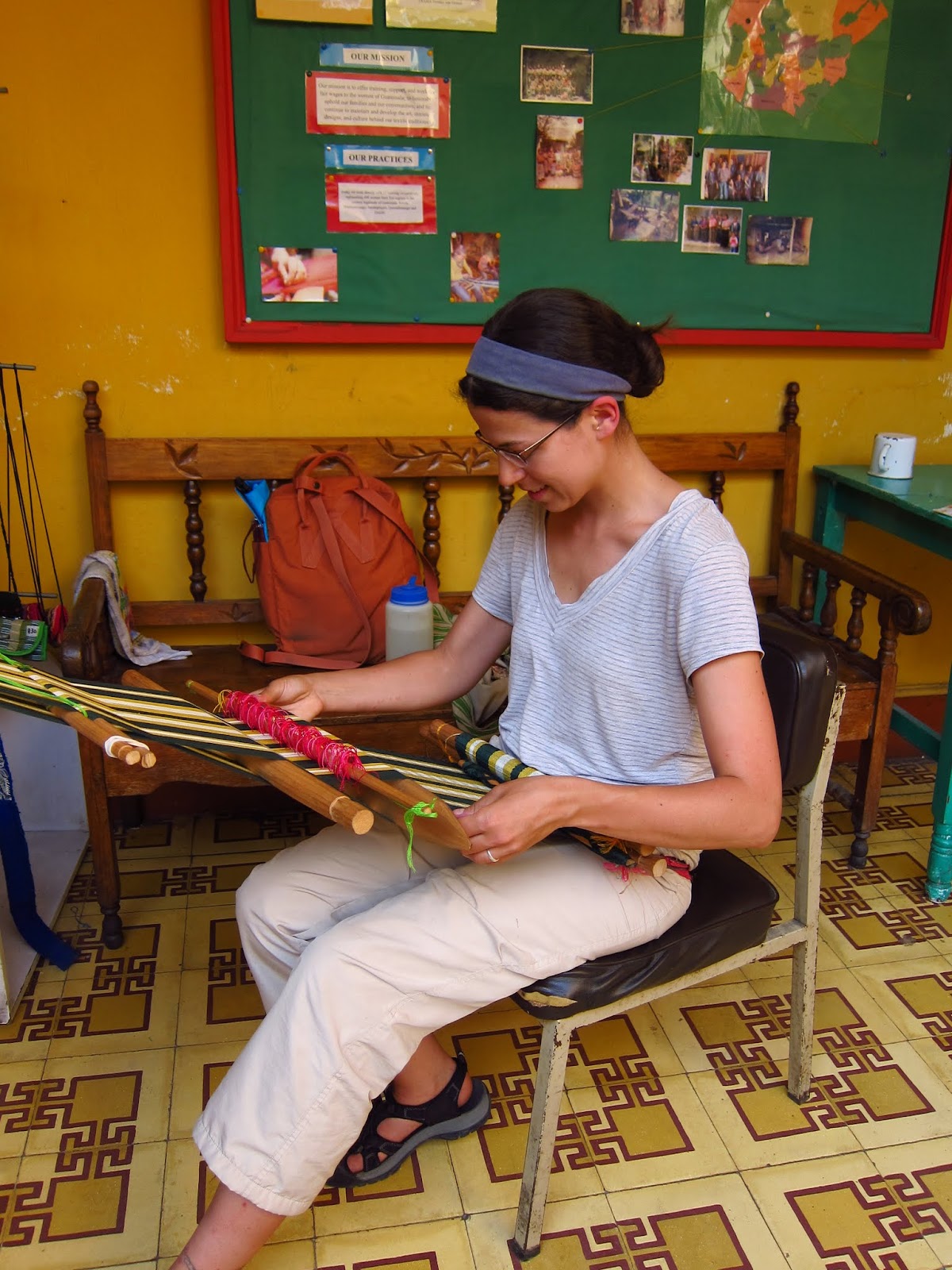
Step 7: Weave! ¡Teja! Weaving is divided into two processes, proceso uno and proceso dos.

Proceso uno:
Lift the laviadura, raising one half of the threads.

Insert the torpidor, an oblong piece of wood, under this half of the threads.

Pack down the threads already woven.

Rotate the torpidor, raising this half of the threads.

Pass the trama, a baton with thread wrapped around it, under this half of the threads. The thread on the baton becomes the weave threads (in contrast to the warp threads, which go lengthwise along the scarf).

Remove the torpidor.

Proceso dos
Slide together the laviadura and the pulito. This raises up the other half of the threads! Neat!

Insert the torpidor under the other half of the threads.

With the torpidor, pack down the thread that you just placed with the trama in proceso uno.

Rotate the torpidor to lift the other half of the threads.

Pass the trama under the other half of the threads.

Remove the torpidor. Start from the beginning of proceso uno again, using the laviadura to lift the first half of the threads!

If that didn't make any sense, here's what the sequence looks like when you put it all together:


Step 8: When you reach the end of the warp threads, cut the piece from the dowels and tie the lose ends in decorative knots.

All done!

Thursday, January 6, 2011

Ithaca Has Given Me the Beautiful Voyage

I met a Columbian in Cambodia.

A jovial man, the type of man who ends up in the middle of everything, he was convincing people on the street to eat at the restaurant where he sat.  Why?  Why not.  There was free popcorn, and this was amusing.

He found out that I was from Ithaca, not the Greek Ithaca.  He asked if I knew the famous poem about the place--the Greek Ithaca, that is.  I did not.

He sent it to me later that week.  Now I carry a copy with me always, in my mind.

I'm going back to Ithaca, my adopted hometown, though just for a visit.  I loved Ithaca--still do--but this isn't the time to drop my anchor in her port for very long.  I wonder what has changed since I left.  I know I have.  I'll go back someday, but that's not the point:  by the time I finally settle down, I don't think where I settle down will matter much.

Read this poem.  Read it slowly.  Enjoy it.  Remember it.  May your journey, not your destination, provide your riches.

Ithaca
Constantine P. Cavafy (1911)

When you set out on your journey to Ithaca,
pray that the road is long,
full of adventure, full of knowledge.
The Lestrygonians and the Cyclops,
the angry Poseidon -- do not fear them:
You will never find such as these on your path,
if your thoughts remain lofty, if a fine
emotion touches your spirit and your body.
The Lestrygonians and the Cyclops,
the fierce Poseidon you will never encounter,
if you do not already carry them within your soul,
if your soul does not set them up before you.

Pray that the road is long.
That the summer mornings are many, when,
with such pleasure, with such joy
you will enter ports seen for the first time;
stop at Phoenician markets,
and purchase fine merchandise, mother-of-pearl and coral, amber and ebony,
and sensual perfumes of all kinds, as many sensual perfumes as you can;
visit many Egyptian cities,
to learn and learn from scholars.

Always keep Ithaca in your mind.
To arrive there is your ultimate goal.
But do not hurry the voyage at all.
It is better to let it last for many years;
and to anchor at the island when you are old,
rich with all you have gained on the way,
not expecting that Ithaca will offer you riches.

Ithaca has given you the beautiful voyage.
Without her you would have never set out on the road.
She has nothing more to give you.

And if you find her poor, Ithaca has not deceived you.
Wise as you have become, with so much experience,
you must already have understood what Ithaca means.

Monday, August 23, 2010

Yankee Girl in Muslim SE Asia

On Friday, I crossed the Malay-Thai border overland, ending two months of travel in predominantly Muslim Southeast Asia (Indonesia and Malaysia).

While the wars in Iraq and Afghanistan grind on, America is having a crisis of conscience and Constitution over the proposed mosque at Ground Zero. Muslim culture couldn't be more alien, frightening, or distasteful to a large percentage of Americans.

I said I would consider writing again if I had something interesting or meaningful to say. In this rather lengthy post, I'd like to share some of my thoughts and experiences as a Westerner in a Muslim culture. There is no substitute for getting on an airplane to live it yourself, but if you can't, the next best thing is hearing about it from someone who did.

From Ramadan McDonald's to my first copy of the Quran, this is a Yankee girl's experience of Islam in Southeast Asian.


Friday, August 20, 2010

Malaysia? What's in Malaysia?

Written September 22, 2010

I'll be honest:  the reason I ended up in Malaysia was because of a cheap flight.  Denpasar, Bali to Kuala Lumpur for about 100 greenbacks.  I needed to leave before my visa ran out, so I figured, "Why not?"

Malaysia was an interesting place.  Just like Singapore is the most un-Southeast Asian city in Southeast Asia, Malaysia is the most un-Southeast Asian country in Southeast Asia.

The standard of living is quite high; Wikipedia tells me that the per capita GDP is roughly USD$14,800, the only country in SE Asia to beat the global average of USD$10,500 (except Brunei, which beats even the United States).  And you can tell it's wealthy, too.  The public transit is clean, efficient, and relatively expensive.  People are well-educated; most speak at least two languages, as English is a compulsory subject in schools.  While I did see some people living on the streets in Kuala Lumpur, the city felt just as modern and clean as Singapore.

Malaysians are an interesting ethnic blend of Malay, Chinese, and Indian.  So even though Malaysia is an Islamic country, defined as such by the Malaysian constitution, there are significant minorities of Buddhists (~19%), Christians (~9%), and Hindus (~6%).  We were in Malaysia for the start of Ramadan, but it didn't affect our travel plans at all.  We simply ate in Indian or Chinese restaurants for breakfast and lunch.

We spent our time in three places:  Kuala Lumpur, Taman Negara National Park, and the Cameron Highlands.

Sunday, July 18, 2010

Hypnotized by Wayang Kulit

I'm a very visual person.  If you tell me something, I won't remember it unless I see it written down.  I can take one glance at a map and find my way around a city for an entire day, but if I see written directions, I won't understand them unless I plot them on a map.  Dave taught me to drive a manual transmission vehicle by waving his hands in front of me to match the movement of his feet.

I think this is why wayang kulit, the Indonesian shadow puppet show, totally hypnotized me.  The puppets are beautiful--the leather is carved so some parts are thinner.  Then, the puppet is painted in vibrant colors with amazing detail, even though the puppets themselves aren't meant to be seen by the audience!  Luckily for me, we were permitted to walk around the stage and the gamelan orchestra providing the soundtrack.

How cool is this?!


So dramatic!  Here's what it looks like from the front...


Here are the rest of the pictures from our time in Yogyakarta...

Sunday, July 4, 2010

Sydney: 24 Hours


We left Tuateawa for the last time on Sunday afternoon, taking the ferry from Coromandel to Auckland. On the ferry, Dave and I met a new friend, Alex (age 7), who was very upset at leaving her mother to visit her father in the city. We played cards, walked around the deck, and admired her school portfolio, and she seemed much happier by the end of the ferry ride.

In Auckland, we had a quick Thai dinner at Food Alley per Bexie's tip (thanks, Bex!). We took the bus to the airport and found a nice bench to spend the night (the first of many nights spent in interesting places).

Once in Sydney, we headed for Circular Quay, home of the Opera House and Harbor Bridge, via the train. The Opera House is much cooler in person than in pictures... it's an amazing work of architecture! The Harbor Bridge was, uh, a bridge. I don't understand why folks get so excited about it.


After a lunch with one of Dave's friends from a 2005 semester abroad in Sydney, we wandered around in the drizzle, wrapped up in our rain shells, backpacks tucked into rain covers. At one point, I found myself eating ice cream in front of a neuron-shaped modern sculpture while watching some parrots and thought, "This is a little bizarre—but I would rather be no where else right now!"


We noticed a crowd of people standing at the waterfront and went to investigate. Someone said it was a free ferry, so we decided to hop on, without really knowing where it went (why not!). It went to Cockatoo Island, a former penal colony/ ship yard that has been turned into a home for contemporary art. We wandered around, watching video of tap-dancing men in white suits feeding meat to wild dogs, contemplating Balinese-style wood-carved sculptures of suburbanites as Eastern-influenced gods, and realized the day couldn't get weirder. Or more awesome.


The next morning, we met up with Dave's cousin Jess, who happened to be in the city for a vacation. We got breakfast, wandered around, and chatted for a while. She's a lot of fun, and I'm happy I got to meet her. After saying our goodbyes, it was time to take the train back to the airport... ready for more adventures!


A few recommendations for Auckland and Sydney: