Pages

Showing posts with label birds. Show all posts

Wednesday, December 26, 2012

June Through December

The second half of 2012... in pictures.

Summer Fun In Ithaca!

jumping for joy on summer solstice
enjoying the sunset at stewart park
not-so-clandestine waterfall jumping at buttermilk falls
sciencenter fun for my 30th birthday (is that what our kids will look like?!)
being temporarily homeless (between apartments) & camping in danby state forest
radishes from our garden
A Visit to North Carolina

mother/ daughter portrait
mummers walking in the gardens
Also,
That One Time I Got Stung By A Bee On My Morning Run
& Turned Into A Baby Dinosaur
rawr
 Then It Was Autumn

autumn's colors at thatcher's pinnacles
autumn walks with diane and fudgie
city and lake views from the top of the maple tree in our backyard
hiking mt. mansfield in burlington, vermont
  Lots of Trips to the Gunks

climbing
more climbing
falling
 And Also A Trip To Rumney

climbing again
more climbing (nice red shirts, guys)
climbing dolt and jolt (no really, that's what the routes are named)
A Late Autumn Trip To Poke-O-Moonshine

it's a gonna be cold, need my finger warmers
adirondack autumn


pano stolen from timo
A Kentucky Thanksgiving At The Red River Gorge

finally on the sharp end
also doing some bird flipping. what?!... it was cold.
Hello, 2013.  :-)

Tuesday, April 17, 2012

At Least There Were Birdies (Copan Ruinas, Honduras)

I had a decision to make in Suchitoto: stay in El Salvador for a few extra days then go straight to Guatemala, or make a small detour north into Honduras before swinging west into Guatemala.  In the end, I decided to head into Honduras (again).  Suchitoto just wasn't as magical as Alegría, and I thought the ruins at Copán might be a neat diversion.

The town of Copán Ruinas was relaxed, for a tourist town.  Many people visit Copán on a grueling day trip from Antigua in Guatemala, leaving the town itself small and tranquil.  Honduras is as popular as El Salvador on the gringo trail (i.e. not nearly as popular as Guatemala or Costa Rica), with not quite enough "to do," so it doesn't get the two-weeks vacation crowd--everyone I encountered was traveling long-term.  Having said that, all of the restaurant menus were in English, and there are travel agencies everywhere... the Archetypal Generic Central American Tourist Village.  Meh.

The ruins were nice, but not awesome.  Compact:  I could walk from one end of the site to the other in 10-15 minutes.  Not crowded, for such a small site.  And holy hot-as-you-know-what under the mid-day sun!
view over half of the ruins
Copán is known for its excellent examples of Mayan sculpture, many in such high relief that they're almost three dimensional.
mayan stela
I enjoyed finding the animal imagery in the carvings, but I thought Nature's efforts to reclaim the site were even more impressive.
the buttress of this tree is probably 30 feet across
But the very best part was the scarlet macaws that live at the entrance!
hi, birdie!!!
The Scarlet Macaw is the national bird of Honduras and has sacred meanings for the Mayan peoples of this region.  The15-20 resident macaws were rescued from the illegal exotic pet trade and now reside in the Park.  A nearby bird sanctuary is working on educational programs for Hondurans and foreigners and hopes to increase the number of scarlet macaws to the wild through habitat protection.

I totally love birds, and I could write an entire blog post just on the Scarlet Macaw (maybe I will!).  So, for me, watching the birds was by far the best experience at Copán.  At least there were birdies!
scarlet macaw in flight
For anyone out there on the internets thinking of going from Suchitoto, El Salvador to Copán Ruinas, Honduras, here are the details.

Friday, March 18, 2011

From Arizona to California

It's raining.  On the one hand:  bummer.  On the other hand:  I can hang out in this nice library surrounded by books and write a few updates!  Picking up where I left off...

Cochise Stronghold:  After Saguaro National Park, we climbed a day at Cochise Stronghold.  Our couchsurf hosts spoke highly of the place, and they were right.  Fantastic granite and thought-provoking moves, even on the easy stuff.  This day, though, I missed my climbing friends in Ithaca and wished that we were together.

yucca and cochise granite

Then California!

Joshua Tree National Park:  the Joshua Trees look so odd, like something Dr. Seuss would draw.  We did a day hike out into the desert and up a canyon.  I'm sick of desert hiking.  Just not the type of place where I feel at home, comfortable, refreshed, at peace--how I usually feel after hiking.

We climbed a half-day since we had quickdraws but no trad rack.  Ooops!  We climbed on Pixie Rock...  lots of smearing and lots of open grip hands.   I desperately attempted to crimp on microscopic numbs and to edge on non-existent features before I gave in to the style the rock required.  Then it went ok, and I climbed my first outside 5.10 (no cheating, this time!).

I thought I would love JTree, but I only liked it.

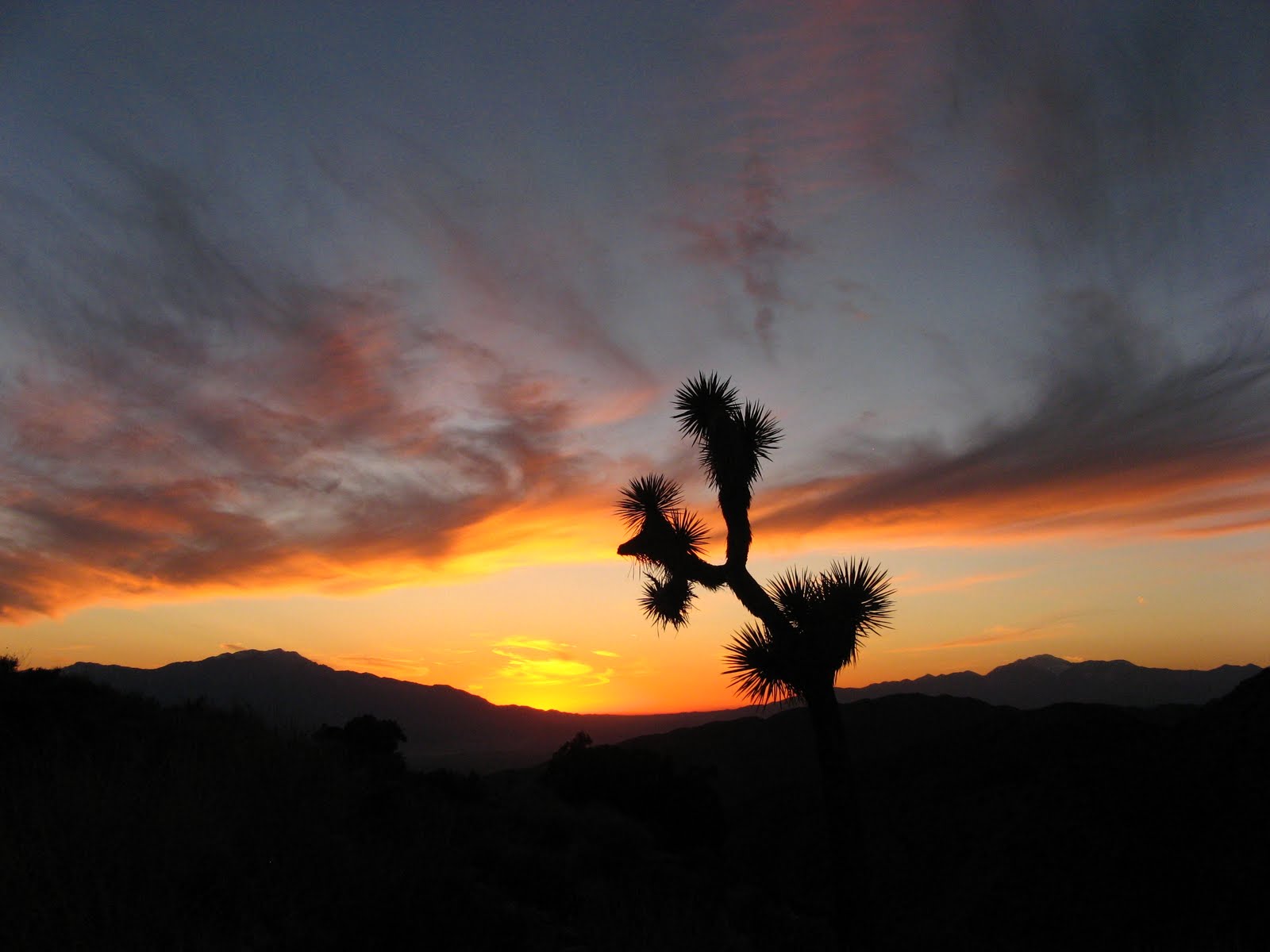
joshua tree and sunset
San Bernardino National Forest:  This was an unexpected stop, since we left JTree early.  AWESOME!!! We hiked the Cougar Crest trail out of Big Bear City to the famous Pacific Crest Trail and Bertha Peak.  The northern slopes were still snow-covered, and there were trees and shrubs everywhere overlooking the lake and the ski slopes beyond.  After a month in the parched, beige and brown desert, this was like awakening!

view of big bear lake from the pacific crest trail (PCT)
We volunteered with the Bald Eagle annual census and spotted an adult eagle soaring across the lake!

our eagle census sheet
After the San Bernardinos, I drove Dave to LAX so he could fly back to the East Coast for a rope access job.  And then, I was on my own!

Saturday, May 15, 2010

Milford Sound, Mt. Cook, & OMG PENGUINS

Yeah, so, we went out to Milford Sound.  It looked just like the postcards.  It's a pretty fiord, yeah, but I have this feeling that it's popular because the tourism industry has made it popular.  We didn't do any of the cruises or anything like that.  Maybe if we had, I would have been more impressed.

looks like a postcard

Kea, however, will always delight me.

who is playing with whom?

We also went to Mt. Cook for a day.  That wasn't that exciting, either; the weather sucked, so I didn't even see the famous mountain.  Unless you're prepared with crampons and an ice axe, there isn't a tremendous amount of hiking to be done in Aoraki Mt. Cook National Park, either.

iceberg. kinda cool, but probably not worth the drive.

On the drive from Milford Sound to Mt. Cook, we stopped in Dunedin and the Otago Peninsula.  Dunedin was a sweet little city; it's definitely my favorite city on the South Island!  I wanted to visit penguin colonies on the Otago Peninsula.  The iSite tourist information bureau told us there was a chance that we might see penguins at a certain beach.  We went to that beach and got talking to a few friendly, kind Kiwis who told us that we'd have much better luck at a different beach.  Puttered down the potholed, one-lane country road, pulled into the carpark, ran down the largest sand dune I've ever seen, and HOLY SMOKES that's a BIG and unexpected mammal!

i think that i could outrun him if i needed to

We did make it to the hide while the yellow-eyed penguins were coming back to land from fishing at sea all day.  I was totally stoked, because yellow-eyed penguins are some of the rarest penguins in the world.

OMG penguins!!!

Here are the rest of the photos, with commentary:

Sunday, May 2, 2010

That Was A Long Day, And Also KEA!!!

On Monday, May 3, we were still trying to figure out how to fit a multi-day trip into the poor weather.  We decided to do a “little” day hike in Mt. Aspiring National Park.  We walked up to the Rob Roy Glacier amidst the snow-capped mountains.  It was very pretty...

mt. aspiring, 3033 meters, in the center

...but if you've seen a bunch of snow-capped mountains before, it was meh.  It was great to put some miles on my boots, of course, but I was actually a little...  bored.  I know.  I'm in New Zealand, hiking through one of the most outstanding national parks, and I'm just not blown away.  Yet.

On the way up the trail, there was a sign warning against feeding the kea.  Kea are alpine parrots.  That's right:  these boys don't fly through the jungle.  They prefer the snow.  Weird, huh?  They have a reputation for being bold, curious, and rather cheeky.  They have learned to open zippers, so you can't leave packs unattended, and they also have a reputation for stealing part or all of boot laces (unfortunate!).  I was a little disappointed that I hadn't encountered one yet.

do not feed the kea

At the top of the trail, Dave and I stopped for a snack under the shadow of the glacier.  Dave said that he was a little bummed that we hadn't seen a kea yet.  I nodded and took a bite out of my apple.  My butt was getting cold, sitting on a rock, so I stood up to stretch.  Behind Dave:

"hullo, there!!!!!"

KEA!!!

He was standing maybe a meter from us, looking right at us and doing that funny swaying thing that parrots do, staring at our backs while we were oblivious to him.  Once we noticed him and gave him attention, he circled us and came right up to us.  He was observing us as much as we were observing him.  He tried to pull some pieces of metal off a post.  He tried to beg for our food.  He tried to pull at my hiking poles.  He almost grabbed Dave's camera.  I was absolutely ENCHANTED.

"are you giving me something?  can i eat it?  can i play with it?"

Of course, we did not feed him.  The only thing he got was a little entertainment, and the only thing we got was a few pictures.

"i am such a pretty birdie!"

Oh yeah, the rest of the day.  We hiked down the glacier path, then out to the Mt. Aspiring hut, then back to the carpark.  It was a full day hike, about 26 km/ 16 miles.  A long day, but the kea made it worthwhile!

Pigs Do Fly

This is the laziest bird I've ever encountered:

"i'm not moving.  you can't make me move."

It's a wood pigeon.  He was hanging out in a cabbage tree in our front yard.  I walked within 8 meters/ 25 feet of him and took a picture of him; he looked at me.  I walked within 5 meters/ 15 feet of him; he ate a few more berries.  I walked right up under the cabbage tree; he turned his rear end toward me.  I extended my hand and took a picture.

He pooped.

Fortunately he missed, but I was again surprised by how placid and nonchalant most New Zealand birds seem to be.  This is what millions of years of evolution without humans, much less any other land mammals, will produce.

"how do i look from this angle?"

Wood pigeons, or kereru in Maori, is beautifully colored in gem-tones of emerald, amethyst, ruby, and sapphire, with a cream white belly and a perfectly round, sunset-colored eye.  Very pretty.  They're quite large, and they seem like they'd be dense and heavy and very nice to hold in your lap, like a cat.  When they jump off a branch to fly, usually the branch moves and they do not, not until they flap their wings hard to keep their large bodies afloat.

But I'm not writing about kereru because they're cute, fat birdies, even though I do like me some cartoonishly adorable, chubby birds.

"and how about this?"


Tuesday, April 6, 2010

Kiwi House

On the way home from Tongariro, we stopped at the Otorohanga Kiwi House to view live kiwis and other native New Zealand bird and animal species.


They keep their kiwi birds in little habitats, and they allow visitors to view their feeding times.  We arrived just in time for the kiwis' 1:30 p.m. meal.  Since kiwis are nocturnal, they keep the habitat light during the night to simulate day, and then put on very dim lights for a few hours during the day to simulate moonlight.

Kiwis are the most ridiculous birds.  First, they can't fly.  They look like little wingless dumplings.  They have incredibly strong legs and feet, which they use for digging, scratching, and fighting.  Instead of a reasonable beak shaped like a hook or a bill or maybe a triangular cone, they have two chopsticks stuck into the front of their faces.  Even stranger, they have little nostrils at the end of their bills, instead of at the top near their faces.  They use their chopstick bills to probe into the leaf litter, snuffling around for insects and worms.

Stuffed (dead) kiwi bird from the visitors' center...  the kiwi house didn't allow photography of their kiwis.

And how do they move?  Let me share a brief, ridiculous example.  You can't make this stuff up.


In addition to the kiwis, the place had numerous other species, the majority of which were birds (New Zealand doesn't have any native land animals).

Putangitangi, the sheldrake duck.  This little guy was wandering around like he owned the place.

The pukeko, another of New Zealand's ridiculous flightless birds.

The kaka parrot.  We have a flock of kaka living in the forest next to our house in Tuateawa.  They have a very distinctive, croaking scream.

There were also a few tuatara and some geckos and skinks.  Even though the tuatara looks like a lizard, it's actually a completely different type of animal, from the order Sphenodontia.  In fact, the two species of tuatara are the only surviving members of this order, which flourished at the time of the dinosaurs!

I'm very special.  Also, my eyes look evil.

On the one hand, I was really happy that we stopped at the kiwi house.  I'm sure I never would have encountered a kiwi in the wild, much less a tuatara or some of the rare ducks.  I think that establishments like the kiwi house help foster an attachment to rare animals that you can't get without actually being in the presence of something incredibly alive and incredibly rare.

Having said that, the less rare but far more memorable, sexy, and flashy kiwi birds generated considerably more interest in the American, German, and Kiwi tourists than some of the far more rare ducks and birds elsewhere in the exhibit.  Is this just another tourist trap, albeit in a feel-good form?

Also, I was unclear of the origins of the animals.  I think (or I would like to believe) that all of them live in captivity because they can't survive in the wild, for whatever reason.  Still, it makes me a little sick to my stomach to see wild animals in cages.

I took this picture of a harrier through the mesh of his enclosure.


I went to take another picture, and my camera auto-focused on the bars.


How appropriate?