Pages

Showing posts with label turkey. Show all posts

Saturday, December 18, 2010

Turkey, I Love You. Let Me Count The Ways...

Turkey was the first country that I was sorry to leave, the first place I can truly say that I see myself returning some day. I've thought about why I love Turkey so much compared to, say, Nepal. Though I can't come up one significant reason that puts this place above others in my mind, my heart is filled with dozens of small anecdotes, minor details ever so specific to Turkey that, together, have made an unforgettable experience.

blue mosque interior
Turkey, I love you. Let me count the ways...
  • Amazing Architecture (not only the Aya Sofia and the Blue Mosque). An Alphabet I can read (first since Malaysia) helps, too. I think Ayran (a yogurt-based drink) single-handedly healed my stomach issues from Nepal.
  • Bazaars, Baklava, the Blue Mosque, and the Bosphorus. Also, the long-distance Buses are fast, clean, secure, and comfortable. Don't forget Bubby and Boss!
  • Cats: the fluffy, furry, fat cats that are everywhere in Istanbul. Couchsurfing in Turkey has given me some of the best experiences of my trip. And Cheese, lots of tasty tasty cheese! 
  • Diyarbakır, city of my heart. Also Döner, Dave's tasty snack on-the-go for about $0.70. 
  • Ethnic pride, specifically Kurdish of southeast Turkey, stands out in my mind. Turks care for the Environment: we saw no trash or graffiti in Pigeon Valley, and the Bosphorus has little to no trash floating in it. The Eggplant here is the best I've ever had (sorry Mummers). 
  • Friendliness. Smiling Thais? Meh. Friendly Nepalis? Get real. The Turks are masters of friendliness. 
  • Göreme. The very first tourist town that hasn't made me nauseous. Quite a compliment, Göreme. 
  • History is everywhere. I got a new skin in the Hamam. Hygiene is so good that the unthinkable—someone touching my food with their bare hands—does not freak me out. Turkey was Hassle-free compared to the rest of Asia. Even the carpet sellers are laid-back and polite! And don't get me started on Hospitality
  • Istanbul. For a city of 18 million, it's not that bad. 
me and my juice
  • Jetties on the Bosphorus where men bring their fishing rods and I snap dozens of photos. I had my first cup of freshly-squeezed pomegranate Juice
  • Kindness to animals. Unlike the Nepalis who throw rocks at dogs and seem to enjoy it, I noticed multiple acts of kindness toward stray animals.  There were three homeless dogs on a random corner, sleeping in a makeshift cardboard and trash bag shelter someone had made for them. A ripped-open clear plastic bag of leftover meat and pasta was at their side as they slumbered, protected from the drizzle. I can't tell you the number of times I saw burly Turkish men with stern moustaches stop in their tracks to scratch a street kitty under the chin. Our couchsurf host told us that stray dogs in Istanbul are routinely tagged and vaccinated as a public service. The Turks' kindness toward animals is apparent, as strays are uniformly clean, calm, and approachable. Some of the stray cats are even borderline overweight! 
  • Lokum (turkish delight) is ok, not to my taste, but I understand why some love it. I prefer the Language, which is much easier than any South or Southeastern Asian language. 
  • Mosques and Minarets—they're everywhere! And, of course, Mr. Turkish Bull
  • Neckties on men serving tea and cakes on the buses. Seriously. Tea, cakes, and neckties. On buses. I rest my case. 
  • Old people sipping çay in a courtyard. Olives sold by the kilo. 
pide
  • Pomegranates, my favorite fruit. I ate a lot of Pide (turkish pizza), which is quick, cheap, vegetarian friendly, and delicious. Perfect street food! 
  • Quiet, quaint villages. It's SO EASY to get off the beaten tourist trail here. Just go anywhere east of Göreme. 
  • Rumi, the mystical Sufi poet, whose masterwork I hope to read at some point. 
  • Sanlıurfa and it's lovely public and historic spaces. Just in time for winter, steaming cups of Salep (powdered orchid root drink) topped with cinnamon. 
  • Tea! Tea! Tea! Anything and everything is an excuse for çay. And Textiles—if you're into fiber arts, carpets, wool, max out your credit card in Istanbul. 
  • Üsküdar and Uçisar, two Unexpected places that feel Untouristy yet welcoming. 
  • Vegetables. After eating only starch and fat for most of Southeast Asia, I hit Istanbul's fruit and veggie markets hard. It was awesome. 
  • Wi-fi. Finally, and internet connection that is fast and reliable? Whoa! 
  • X is the intersection between "west" and "east," "old" and "new." And it's true. Turkey brings it all together. 
  • Yoğurt. Oh, so this is what yoghurt tastes like without additives, stabilisers, and flavor enhancers. America, yer doin' it wrong. 
  • Zero moments when I questioned my decision to travel or what I was getting from/ giving to the experience. 
To be fair, there were moments when I wasn't feeling so keen on Turkey. Four out of five days in Istanbul brought nasty, cold, damp weather. I was hardly in the mood to wander around random neighborhoods, and there isn't much nature in the city. I regretted giving five whole days to wandering around Istanbul and wished I had spent a day or two in another city, perhaps Konya.

A few other less-than-perfect points:
  • Overnight bus rides (though, admittedly, those have been my choice); 
  • Getting lost (though someone has always offered to help us become un-lost); 
  • Some people have been over-zealous in sharing/ pushing their Muslim faith; 
  • Food and accomodation in touristy areas is expensive and poor value (i.e. you don't get much for the cost); 
  • Google Voice doesn't work; 
  • I wasn't able to download NPR podcasts. 
If I'm whining about missing NPR instead of missing clean drinking water, then I guess I don't have much to whine about.

Three cheers for Turkey!

Friday, December 17, 2010

My Turkish Hamam Experience

Subtitled:
Scrub-a-Dub-Dub, It's Time for the Tub
or
How I Came to Know Bubby's Boobs
or even
Grey, Tarry Turd Caterpillars

Back in the day, before most Turks had nice bathrooms in their houses, everyone went to a hamam, or community bathhouse, to clean up, relax, socialize, and gossip. One of the things I wanted to do most in Turkey was to visit a hamam. Why? I've gotten quite dirty from traveling for a year. Like, really dirty. And why not? (For your own sake, note that this sentiment most often leads to humiliating and/or grand adventures.)

There are a few tourist-oriented hamam that charge waif-like French visitors 75 Euro. But I (stupidly?) wanted the real deal: the "local experience" with "local women" at the "local price." Our couchsurf host pointed us to Çenili Hamam on the Asian side of the Bosphorus.

that's it
Dave and I found the place without too much difficulty and planned to meet up in 90 minutes. The ladies' side was clearly labeled "bayan." Deep breath. Let the adventure begin.

Thursday, December 16, 2010

Istanbul in Images

This is what I saw in Istanbul.

a man selling mussels plucked straight from the bosphorus

on every street corner, doner (meat on a stick next to a fire)

itty bitty turkish kitties EVERYWHERE...  and lots of people being nice to them

the blue mosque/ sultan ahmet mosque

a very grand bazaar

more fruits and veggies than i could eat in 5 days, though i tried valiently

old stuff

the bosphorus
the bridge between old and new, east and west
More images here:

Wednesday, December 15, 2010

Zeytinyağlı Yeşil Fasulye (Green Beans in Olive Oil)

I had this multiple times in Turkey, and I plan on making it when I return to the U.S.A.  Maybe with a little less olive oil, though...

  • 1/2 kg runner beans (or green beans)
  • 1 onion, very finely chopped
  • 2 cloves of garlic, roughly chopped
  • 2 or 3 tomatoes, peeled and very finely chopped
  • 1/2 c. olive oil (you read that right)
  • 1/2 to 1 1/2 c. hot water
  • Sugar and salt to taste
Clean the beans (remove top, tail, and string, if applicable).  Chop into 2-3 inch segments.

Saute the onions and garlic until onions are turning clear.  Add everything else, bring to a boil, reduce to a simmer.  Cook until beans are soft but not mushy, 30 minutes to 1 hour, depending on the type of bean.

Remove from heat.  Serve at room temperature.

(Apparently, this can be made in a pressure cooker, as well.  Cook the beans about 15 minutes.)

Monday, December 13, 2010

Cappadocia in Winter

Thinking about visiting Cappadocia in winter? Good idea.

Cappadocia, or Kapadokya as Turks spell it, is known for its beautiful rock formations. A long time ago, a volcano belched out the precursor to a layer of soft, gritty rock. Over time, wind and water have eroded the rock into pillars, caves, and arches. Enterprising humans (or just Christians looking to lay low) constructed everything from pigeon coops to houses to churches inside the soft rock. An entire tourism industry has sprung up around hot air balloons, guided walks, and ATV rides around the countryside.

Davo and I stayed in Göreme, a village full of pansyions advertising cave rooms and tourist restaurants advertising meats cooked in special clay pots. Yes, we stayed in a cave!

our cave dormitory
Lucky for us, we visited during the off-season. We were two of about 20 tourists in the entire quiet, low-key, laid-back town. The rock formations don't change with the lack of tourists, though, and the setting of the village is lovely. Göreme is the very first tourist-oriented town that I've actually liked.

the village of goreme
Even luckier for us, the very first snowfall of the winter coincided with our arrival. All of the rock columns, cliffs, and cones were frosted with the purest white, glittering snow. So pretty.

so pretty!
Since we've put in a collective 13 years in Upstate New York between the two of us, a little snow was not going to stop the hiking.

snow?  i eat snow for breakfast.  BRING IT, WINTER!
We walked through Pigeon Valley to Uçisar, only about 4 easy km each way. The track was difficult to find, since it was covered in snow and there were no other tourists about. Actually, the first day we couldn't find a crucial turn at all, but we got it right the second day.

"we go that way...  i think."
Highlights of the hike were the a-may-zing views from Uçisar and the pups that played in the snow all the way down the hill.

our pup friends
view from the top
I probably would not have liked Kapadokya at all if I had visited during the main tourist season. Having the place to myself and playing in the snow for the first time this winter made my experience there memorable and enjoyable.
fairies live here :-)

Friday, December 10, 2010

Adventures with Old Maps, Buses, and Trusting Strangers

Maybe we shouldn't carry a guidebook that's 10 years old.

Well, we don't usually carry a guidebook at all.  Our experiment with Lonely Planet in Indonesia was a disaster--so much energy wasted on making sure we saw each and every temple (really, after two or three, they all look the same) and getting frustrated when the quoted prices were totally different than LP's estimates (and they always were).  Otherwise, we've been mostly guidebook-free, relying on internet research and asking around to make our way.

But then I ran across an old Turkey guidebook in Nepal for only 200-something rupees, and I couldn't pass it up.  I mean, Abraham's birthplace has been, well, Abraham's birthplace for the past 6,000 years, so certainly I could use the guidebook to research interesting cities and sites.

According to the map in the guidebook, Şanlıurfa's old city center is only 1 km east of the otogar, or bus terminal.  We stood facing east, looking down the road.  Not much in that direction, just dusty beige hills in the distance.  Hmm.

I popped my head into a bus and asked, "Şanlıurfa?"  The driver pointed to the other side of the road, the side that heads west.  Not east.  Hmm.

A man stopped his car on the other side of the road.  I think he was asking where we were going, and we said, "Şanlıurfa!"  He waved us to the other side of the road.  I looked at Dave, puzzled, then looked at the map again.  Yep, east is still on the right side of the page.  We want to go east.  Hmm.

The man flagged down a west-bound bus for us.  The driver actually exited the bus and waved at us.  Hmm...

I hesitated.

The man charged across the street like a testosterone-pumped bull charging a red cape.

Thursday, December 9, 2010

Father Abraham (In a Purple Headscarf?)

After Mr. Turkish Bull got our stupid, foreign asses onto the right bus, we found ourselves in the middle of Şanlıurfa. On a whim, I dragged Dave into a bookstore, where I scored a pocket Turkish/ English dictionary for 3 lira.

This came in handy, as shortly thereafter we were mobbed by a dozen young boys who would be our friends for the afternoon. Twelve-year old Mahmut somehow had a Turkish/ English phrasebook with him, so we swapped phrases such as, "I hope you have a safe journey" and "How many children do you have?"

little mahmut in the white shirt next to dave
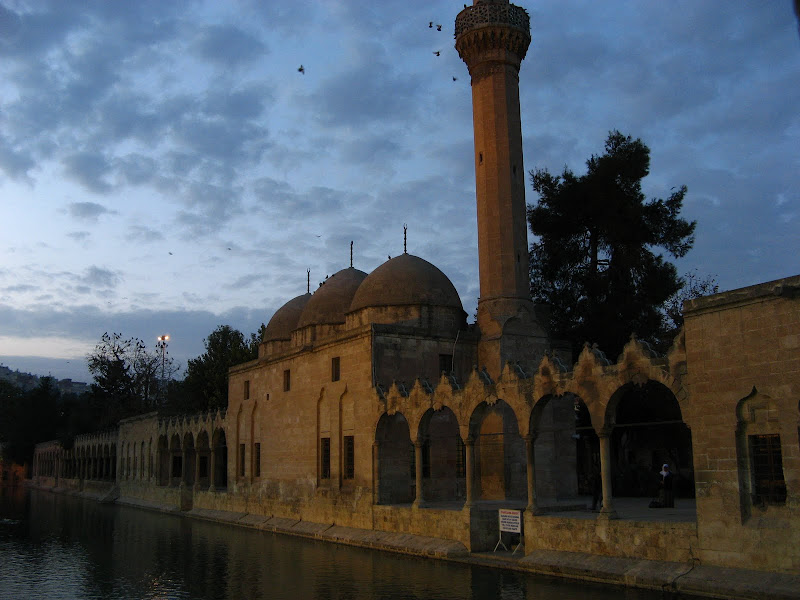
The boys decided to take us to "Fish Lake." As the legend goes, King Nimrod got really pissed off at Abraham and threw him into a fire. God/ Allah was all like, "Oh no you don't," and He turned the flames into water and the coals into carp. The fish in this pond are huge, glossy, and very excited to eat the pellet food sold by vendors in the park.

"fish lake" at dusk
The next day, we made a pilgrimage to the cave where Prophet Ibrahim/ Patriarch Abraham supposedly was born. The sign next to the door noted the segregated sides for men and women and requested that women to wear long skirts and headscarves (and to refrain from taking photos during prayer). Fortunately, I happened to wear my long skirt and to have a scarf in my bag.

entrance to ibrahim's/ abraham's cave
I don't think I would have taken any pictures, anyway. The mood inside the cave is pretty intense. Women swathed in the purple headscarves typical of Şanlıurfa sat on carpet squares in tight rows, either praying or sitting quietly. One woman was reading a beautiful Arabic Quran. Some women were filling up cups or bottles with holy water from a spigot. A little boy ran around, occasionally shrieking. One woman was crying.

It blew my mind to think that Abraham was born here, oh, plus or minus 4,000 years ago. And this city has been continuously inhabited for nearly 6,000 years! Even the historical Buddha was born "only" 2,500 years ago. Such history! And how lucky I am to have visited so many sacred places this year. Too bad Christians, Muslims, and Jews seem to forget that they are all children of Abraham...

urfa's citadel
After visiting Abraham's cave, we climbed to the top of the Şanlıurfa kale, or citadel, to enjoy the great views of the city. Highly recommended, it was a lovely little walk.

other tourists at the top
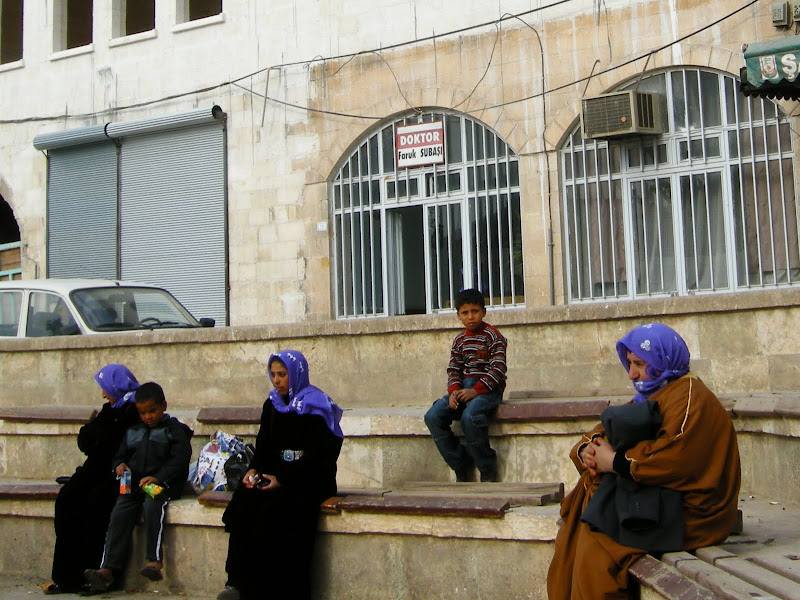
Şanlıurfa fashion is... distinctive. Many women wear traditional clothing: a velvet, floor length dress with a leather belt, a velvet cloak, and then another light brown cape. It reminds me of medieval dress. Both men and women wear purple headscarves, apparently all the rage this year. But there are also many women who wear trendy long skirts and snazzy, urbane long jackets.  This is Turkey: part West, part East, part modern, part traditional.

women in typical urfa dress
How could I resist? My lone Turkey souvenir is a trendy purple Urfa headscarf.

this picture destroys any chance at holding public office in the united states.
(i'm not sure i'm disappointed.)
but isn't it a pretty color?
Did Father Abraham wear a purple scarf?  I guess we'll never know...

Wednesday, December 8, 2010

Diyarbakir, My Heart (Or: How To Communicate Without a Shared Language)

We flew from Kathmandu to Sharjah in the United Arab Emirates.  The only thing I'll remember about the UAE is that drinking water is not freely available in the airport--guess that's what happens in the desert?  The flight from Sharjah to Istanbul didn't arrive until midnight, so in typical Davo and Nico style, we slept on the cold marble floor of Istanbul's Sabiha Gökçen Airport.  The following afternoon, we flew to Diyarbakir, a predominantly Kurdish city in southeastern Turkey.


Why Diyarbakir?  Why not.  ;-)

Ok, I'll stop being cheeky.  :-P  The well-worn grooves in the Asian backpacker tourist trail left me disillusioned with the potential for meaningful travel experiences.  I wanted to get a little farther off the beaten path.  Most tourists to Turkey stick to the western half of the country, but everything I've read highly recommends a visit to the eastern half.

Sold.

It was clear that we were the only foreigners on the flight to Diyarbakir.  Diyarbakir's airport terminal is smaller than Ithaca's.  All signs were in Turkish.  We said, "Otobüs" to some men in uniforms.  It worked!  The pointed us outside.  The bus driver knew only one English word:  "Yes."  Well, I guess it's time for adventure!

We were dropped off at some place near the old city.  I'm used to locals staring openly at me, and we sure drew some attention.  Within five minutes, a group of children had noticed our big backpacks and circled us like puppies wanting playtime.  A young woman shook Dave's hand vigorously and kissed my cheeks multiple times.  This was the pattern for the next few days:  someone talks to us loudly and slowly in Turkish, repeating the words again and again, as if that would help me magically understand (it's hilarious!!).

ercan, ugur, and another guy whose name i forget
Ten minutes later, three non-English speaking students befriended us and appointed themselves our unofficial tour guides for the evening.  Together, we toured the "mean streets" of Diyarbakir.  Diyarbakir had/has a bit of a bad reputation due to local activity by the PKK (Kurdistan Workers' Party), a terrorist organization according to the USA and the UN.  This is a poor city by Turkish standards, and my impression is that many Turks from the west find it backward, provincial, and conservative.  Young people frequently told me that they had 7 or 8 siblings.  A surprising number of men sit in teahouses in the middle of the day--unemployment is high.

We visited the city walls, the central bazar, and the Ulu Mosque, and we drank tea together.  The students identified themselves as Kurds, not Turks, and were very proud to teach us Kurdish words and to drink Kurdish tea.  Kurdish pride is everywhere and constant.  When the man selling me a bus ticket randomly indicated that Diyarbakir was Kurdish, not Turkish, I said "roj bash" ("hello" in Kurdish) to him, and I thought he would die of happiness on the spot.
woman wearing the white headscarf typical of diyarbakir

muhammed and sabra
As we were walking to our couchsurf host's apartment, a man stopped us to invite us to dinner at his home.  Muhammed, who is studying to be an imam (Islamic leader), lives with his mother and his sister.  We learned that his family is Zaza, which is related to but not the same as Kurdish.  His mother made an amazing vegetable dish of eggplant and tomato, served with bread and rice, with a drink of ayran (a watery yoghurt).  It was delicious!  When she saw Dave's bare feet, she insisted on giving him a pair of socks.  I liked her a lot, and I think she liked me, as well.

We spent this entire evening in the company of new friends who know maybe a dozen English words between them.  A shared language is not necessary for communication, nor is it necessary for a good time.  With the university students, we pantomimed our sentences like a three-hour game of charades.  Better entertainment than communication, but guaranteed to provide plenty of laughs!  At Muhammed's house, we used Google Translate to "talk" back-and-forth.  The translations aren't always perfect, but it's possible to talk about more than "I like ___" and "This is called ___ in my language."

on top of the city walls
The next day, we wandered around the old city again.  My journal lists twelve separate awesome interactions with Diyarbakir citizens, from someone who wanted to practice English with us to multiple invitations for tea.  The old itself has a medieval feel, a twisting maze of tiny streets flanked by ancient taupe buildings.  I had the best meal since New Zealand--some sort of cold eggplant dish with rice, fresh bread, and multiple salads.  Pomegranates, olives, and cheeses are sold on the street.  We climbed up onto the city walls and watched the sun set over the city.  There is nothing to interest tourists here, and that is precisely why I love Diyarbakir.


the courtyard of a centuries-old hotel,
back when europe was in the dark ages and the muslim world was the light of civilization
I couldn't take enough pictures to truly express our experiences, but here's a start: