Pages

Showing posts with label conflict. Show all posts

Monday, April 30, 2012

The Purple People Hike from Nebaj to Todos Santos

Apparently tiny shoeshine boys like frisbee.  Or maybe they just wanted a chance to be a kid for once.

In the central square in Nebaj, a village in the northwestern highlands of Guatemala, Dave was throwing a disc with a tall guy named Steve.  A dozen little boys fought for their attention and their toy.  Soon four older girls joined in (you go girls!); one of them had a decent throw and sent it to Dave every time (aww!).  Older boys stood around the outside of the circle, looking cool and desperately seeking a way into the circle without looking too eager.  Men sat on the church stairs and watched the show.  Women walking through the square appeared confused, annoyed, and amused.
frisbee in the main square
 A few of the boys crashed into a puppy pile, trying to rip the frisbee away from each other.  Steve, who just spent seven months working in an orphanage in eastern Guatemala, broke up the fight with a twitch of his head and a shake of his hand.  He took away the frisbee and walked out of the square.

The kids followed him.

He sat down on a bench.  The kids crowded around him.  They stared.  He stared back.

Steve launched into the funniest clown routine I've ever seen.  He made faces, pulled his ears, made his eyes big and small.  He made a rock appear and then disappear.  He switched around kids' baseball caps.  The kids squealed and hung their round, wide eyes on his every movement.  The adults around the square, who were pretending not to watch, snorted and smirked.  He was hilarious.
steve clowns with the kiddos
So began our walk through the northwestern highlands of Guatemala, starting in the village of Nebaj and walking west to Todos Santos.  It took six full days, two travel days plus four days of walking, to make the trek.  Here's what we did:


Yellow: places we slept. Blue: villages we walked through.
Buses: where we took public transit. Tree: La Torre, highest non-volcanic point in Central America.
View Nebaj to Todos Santos in a larger map.

We organized the trek through Quetzaltrekkers, an all-volunteer organization that leads outdoor adventures to raise money for Escuela de la Calle, a school and safe haven for disadvantaged youth.

I could go on and on and on about the trek, but Dave and I had so much fun that we immediately signed up for another trek with Quetzaltrekkers as soon as we got back to Xela.  So, this will be a quick summary of the trip.

DAY 1:  Nebaj

Day 1 was a travel day from Xela to Nebaj.  In Nebaj, we checked into a guesthouse for the evening, wandered through the market, and settled into the central square for a bit of frisbee.  The women in Nebaj wear slim, red traditional skirts.  My stomach was still a bit touchy, so I went to sleep immediately after dinner.

the ayudante ties stuff to the roof of the chicken bus... while it's in motion
DAY 2:  Xexocom

Right out of Nebaj, we hit the first big hill of the trip.  We crested the ridge and meandered down to the village of Acul.  This region has a very deep, very tragic history, particularly related to the recent civil war.  Seventy-nine out of 80 villages in the region either suffered massacres or were burned to the ground.  In Acul's case, villagers were forced at gunpoint to hurt and kill each other.
the village of acul
 After our somber break in Acul, we hiked through green pastures to, of all things, a cheese farm run by Italians.  It's a small world, after all!  We passed through the village of Xexuxcap and out of town along a dirt road.  The scenery reminded me so much of the Himalayan foothills in Nepal, steep and green and steep.  We followed the dirt road as it climbed across a hill and arrived in Xexocom, our home for the night.
reminds me of nepal...
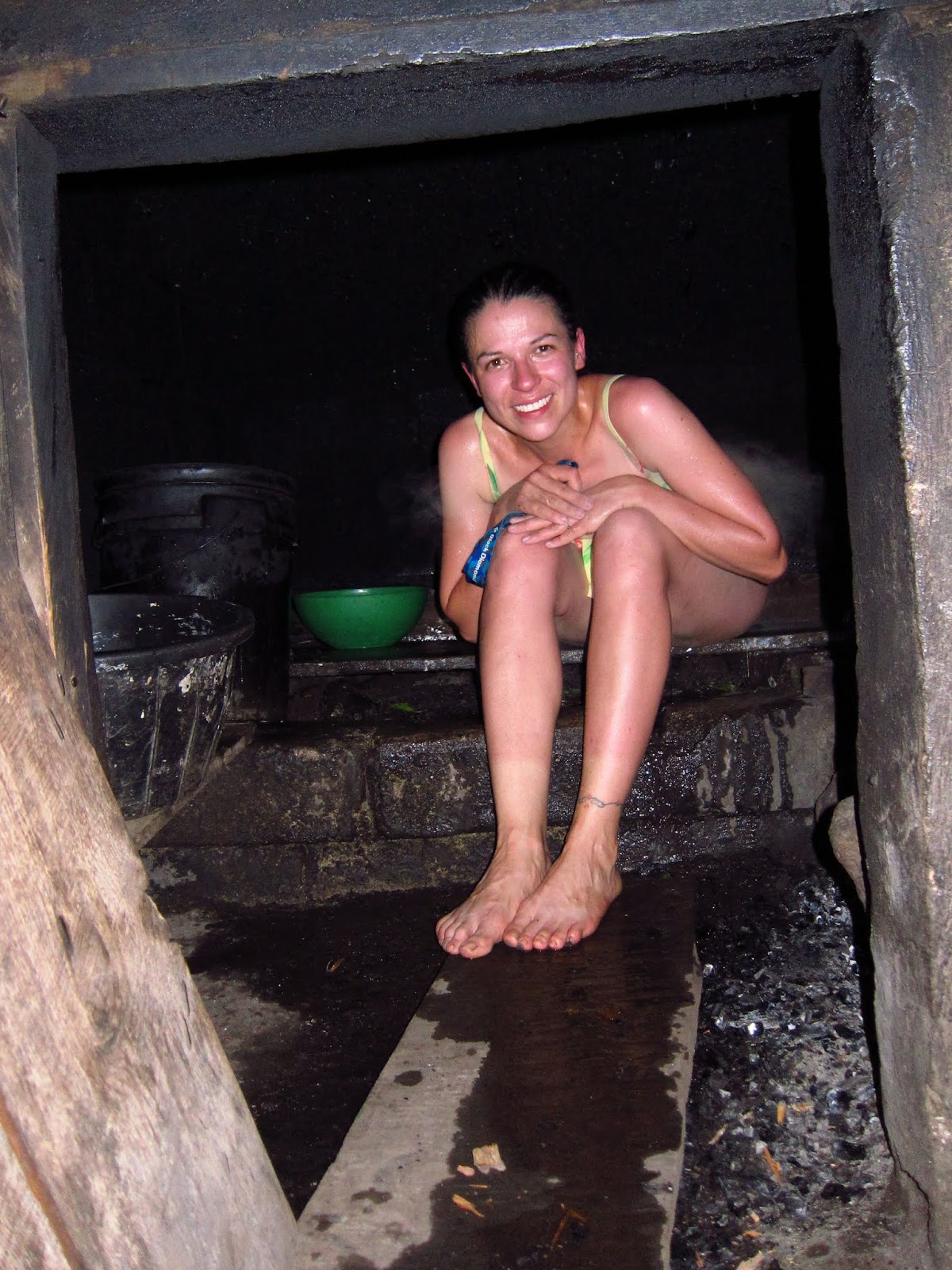
We set up our camp in a school house.  Then, we took turns in a local family's tamascal, or traditional mayan sauna.  It was dark and steamy, relaxing and refreshing.  We had a dinner of rice, beans, an egg, and lots of corn tamales prepared by the same family.  Quetzaltrekkers rotates host families in the community so everyone can benefit.  Apparently, this is a nice economic boost for families, for not a lot of extra work.  Good to see money going directly to people who rarely, if ever, benefit from international aid.
camping out in the school
DAY 3:  Canton Primera

3:30 a.m. wake-up call, and we're hiking by 4:00 a.m. up the hill of 87 switchbacks.  It wasn't too bad, lots of huffing and puffing but it was so steep that we made fast progress.  We watched the sun rise over Acul, and Nebaj beyond.  Most of the way up the hill, we stopped for breakfast and basked in the morning sun.  From breakfast we hiked uphill again to reach the edge of the altiplano.
first glimpse of sun
I have never seen anything like this altiplano before.  Lots of green pasture, interrupted constantly by grey rocks of every shape and size.  Really stunning scenery!
shepherd on the altiplano
We passed through the villages of Chuatuj and Chortiz.  This was probably the most remote place I've ever been.  Instead of people smiling and waving, villagers stared from a distance, or just ran away entirely.  Our guides told us a story about a trekker pulling out a camera in Chortiz to take a photo of some kids.  The kids dropped to the ground and cowered; they thought the camera would steal their souls.  I have very few photos of people from this trip, even though they wear beautiful clothing.
distant horseman
The weather clouded up and it looked like it would rain.  Nice atmosphere to hike across the altiplano.  At the edge, we descended into the Pericon Valley to the village of Canton Primera.  There, we set up camp under the eaves of a decaying school.  We made a campfire and ended up cooking our pasta over the flames.  Played a game around the fire until an early bedtime.
dinner over the campfire
DAY 4:  La Ventosa

First thing in the morning, we walked down to the Pericon River, where we made breakfast and took a long break.  Looong break--this group does 2-3 hour meal breaks!  Dave and Lisa jumped in the freezing water.  Crazy.
crazy.
The hike out of the Pericon River Valley, through the village of El Pericon, and onto the second altiplano was way longer and harder than I expected.  I had the "Day Three Blues" (the third consecutive day of hiking is always the hardest).
pericon river
The second altiplano was not as spectacular as the first.  We followed a dirt road through scrubby pastures to the village of San Nicolas, which had a road.  People here have much more contact with the outside world; they waved and smiled as we passed.
guy on his bike, driving a few horses loaded with firewood
We had lunch under the shade of a lone tree, within sight of "The Hill of Terror."  It actually wasn't that bad. Dave was sick and he did it in under 10 minutes.  Crazy.
thumbs up (then he puked)
Descending the Hill of Terror, we ended up at the paved highway in La Capellania, where we picked up a microbus to cut out the walking along the highway.  We spent the night in La Ventosa with a man named Geronimo and his family, where we enjoyed another tamascal and a dinner of mashed potatoes with tortillas (starch and more starch).
sweating in the tamascal
DAY 5:  Todos Santos

We left La Ventosa with one of the family dogs, named Negrita, who would follow us all the way to Todos Santos and spend the night with us.  She does this with every group, enjoying the attention and the food the trekkers slip to her.

More uphill.  This trek actually does have more uphill than downhill, which is fine for my knees.  This uphill wasn't too steep, and we made good time up to La Torre, the highest non-volcanic point in Central America.  Ginny shared a very sad story about Geronimo's family and the village of La Ventosa from the civil war as we looked out over the valley.
view from la torre
From the high point of the trek, there was nowhere to go but down.  Down, down, down.  We descended through a cloudy, misty pine forest into a lush, mossy forest.  Down, down, down.  Eventually I needed a break for my knees (and my brain, downhill takes concentration!).  Turns out we were only 15 minutes from our lunch break, which we took at the base of a beautiful cliff overlooking the Todos Santos valley.
beautiful lunch break location!
The rest of the walk was easy; a Peace Corp volunteer had raised funds to construct trails within this park.  At the highway, I decided to take a bus directly to Todos Santos with Dave, as he wasn't feeling well, and Katie, who had an ankle injury.  The rest of the group continued through the valley.  We waited a while for a bus, but fortunately one did arrive eventually.
ceremonial putting away of trekking poles
In Todos Santos I wandered around with Katie, then met up with the group for a celebratory beer or three at a local cantina.  Our host family made us rice tamales for dinner, and we had a few more drinks in our room with a lot of laughs.
central square in todos santos, complete with guys in traje (traditional dress)
DAY 6:  Quetzaltenango

Not happy to be awake at 4:00 a.m. but our bus leaves at 5:00 a.m.  The first bus ride is surprisingly comfortable, and we get a very very quick bathroom break in Huehuetenango where we change to a chicken bus.  We're back in Xela's bus yard by a little after 9, and back at the QT office before 10.  We de-issue gear, swap photos and email addresses, and pay for a room upstairs.  Then it's time for a well-deserved nap, a hot shower, and a solid lunch.
the purple people!

So, that's the quick summary.  The highlights were the altiplano, the tamascals, the beautiful forest descending from La Torre, and the cute little dog that followed us on the last hiking day.  More photos from the trip are here.  I think they're worth a look!

Gotta run, I've still got to pack for the next trek and we're meeting the group at 6:30 a.m. tomorrow!

Thursday, April 12, 2012

The Hills of Estelí and the Creep of Somoto

After hot-as-an-oven Granada, Estelí was a breath of fresh air (literally), as it sits at 850 meters (~2,800 feet) above sea level, surrounded by dusty hills.


It's tobacco growing country, and one of the most important cigar-producing cities in the world.  I've heard some folks say that it has a bit of a "western" feel, and I can see why...  lots of cowboy hats and cowboy boots around town.

Estelí was the location of some pretty intense fighting during the Sandinista civil war against the Somoza government during the late 70's, and the city was heavily bombed.  During my last class with Sylvia, I came across a sentence that I didn't quite understand on one of her worksheets:  "Aquí era delito, era un crimen ser joven, era razón de ser perseguido el simple hecho de ser joven."  Or: "Here it was a crime, the crime was to be young, it was a reason to be persecuted for the simple fact of being young."  I asked her what it referred to, and she explained that during the war, the government forces were particularly brutal on the youth of the country, suspecting anyone under a certain age of being part of the insurrection.  There is a small museum in Estelí dedicated to the young people who were murdered during the war.

I didn't make it to the museum, though, because I had an incredibly "unproductive" time in Estelí.  Attempted to find postcards; could find exactly two in the entire city.  Attempted to find an open post office to buy stamps; post office inexplicably closed.  Tried to find the aforementioned museum; found something that resembled a museum, but the premier exhibit was a demonstration of the "progress of technology" (i.e. several dusty typewriters and an ancient computer monitor).  Never mind.  I wandered around the city and enjoyed not being covered in sweat.

To make my way toward Guatemala to meet Dave, I needed to head northwest, across Honduras and into El Salvador.  A national park in Somoto protects a deep canyon through which flows the Río Coco.  I thought I would stop there for the day to check it out.


View Larger Map


origin of the rio coco
I took a bus from Estelí to Somoto and was met at the stop by my guide for the day, Franklin. Franklin works for the head guide in the region, Mr. Henry Soriano. Franklin brought me to Henry's house, where I stashed my backpack and got the quick run-down from Henry.

We walked up the highway a bit, then off into the dusty hills.  It did occur to me, "Hey, I'm walking off into the middle of nowhere with some Nicaraguan guy I just met," but I have to say that Franklin was nothing but sweet, considerate, and friendly.

Once we got to the river, Franklin helped me across the rocks, and we were off into the canyon.  It was a very pleasant day.  We'd walk along the rocks for a while, the get in the water to swim or wade for a while.  Even though I don't really like being in the water, and I swam quickly so I could get back to the rocks, I was enjoying myself.

Eventually we got to the end of the canyon, which is the narrowest and most beautiful section.


And, in case you're wondering, all that rock is most definitely climbable (yes, I checked it out).  You'd have to deal with a very wet rope and the enormous spiders that live on the walls of the canyon, though!


Soon after the prettiest part at the end, we met another group (two American guys and a Swedish girl) guided by Henry's brother for a boat ride to get out of the river.  This, unfortunately, is where the story takes a turn for the worse.

Thursday, December 23, 2010

Breaking the Silence in the South Hebron Hills (Part 3 of 3)

"To Control Them, They Must Fear Us"
Life in the South Hebron Hills

On a bright Thursday morning, Davo and I met a large group of internationals on a central street in Jerusalem. We piled into a charter bus, and off we went.  After only a few minutes on Highway 60, we had passed the green line from Israel into the West Bank.  The only change I noticed was a tall, concrete barrier on the side of the highway:  the separation barrier (yes, there is even controversy regarding its name).

the separation barrier
We drove to several viewpoints around the settlements at Susiya, Metzadol Yehuda, and Ma'on.  The landscape there was three colors only:  beige rocks and dusty dirt, dark green scrub and trees, and a big, blue sky.  The sun felt hot and strong, even though the air was cool.  Silence, except for the voice of the BTS guide.  It felt like there wasn't much around me, just emptiness and tension.  "Is this what people are fighting over?" I wondered again and again.

the land of the west bank
I had a hard time writing about the stories our guide told us.  He didn't talk about flagrant human rights abuses--it's easy to get worked up over rape, murder, torture.  Instead, he told us numbing, maddening, frightening little anecdotes.  He told us about Arabs chafing under the infuriating hassles of Hebron life, about "mapping" houses, checkpoints, curfews.  He told us about rock-throwing "pay the price" radical settlers who have declared that they will punish their Palestinian neighbors if the Israeli government enacts a settlement freeze.  He told us about 18-year old Israeli soldiers with automatic rifles, too much time on their hands, fear in their minds, numbness in their hearts.

In short, the situation just sucks.  For everyone.  Suffering exists, and it exists here.

the group at a viewpoint
Our guide explained the process of "mapping" an Arab home.  A soldier checks to make sure that the place is considered "innocent"--one doesn't want to wander into a den of terrorists.  Once an "innocent" house has been identified, the soldiers enter the home, segregate the male and female residents, question them about anything they want, go through their home, poke into closets, make a literal map of the layout of the rooms.  The point is to destroy any sense of privacy, of "this home is my castle," to ensure that the occupants know that the military is always present and has absolute power.

Concerning the IDF, the ease in which you actually do whatever you want to do unsupervised, that is, enter people's homes, conduct random searches.  Every officer, every commander can decide now I'm entering a home, ordering the family out, ransacking the house...  [...]  There are things, I believe, that an army should't do, like close schools; simply enter a school and: no school today.  Without asking too many questions.  That's it, in a nutshell.
Soldier testimony, Breaking the Silence: Soldiers Speak Out About Their Service in Hebron, page 8, Published by Breaking the Silence

Our guide explained that checkpoints are seemingly placed arbitrarily and enforced arbitrarily.  This person gets through, this person does not.  Open today, closed tomorrow.  Closed today, open tomorrow.  It becomes impossible to run a business, to hold a job, to make a doctor's appointment, to maintain family ties...  never mind trying to work your land.

Same deal with curfews.  Now it's possible to go outside.  Now it's not.  The orders come from above.  The soldiers can't explain why--they don't know.  "You just can't.  No." 

There’s a city, and a road that runs through it, and then one day someone decides “this road is a strategic asset”. In other words, we need it. We, the State of Israel, need it. So Palestinians may no longer use it. So what do they do? Go all the way around it. For a Palestinian to cross a street that is not even a main road, just a mere… street, he has to bypass the whole center of town in order to get to his destination. SO if a guy wants to visit his cousin across the road - and this is a hill-town, mind you – he’ll walk all the way around the city center in order to get there. Of course he’ll be running into countless barriers on the way.
This is not a normal life routine. You can’t live like that. You can’t get through the simplest day. 
You can send your kid to school in the morning, but no one can guarantee that 10 minutes later soldiers won’t come along and close the school, or at noon time… 
And always the uncertainly, and all within army routine. Everything is decided in seconds. A message comes through, originating somewhere among the top brass, God knows where, and ends up with the simple soldier that has to set this curfew: “Today there’s curfew in H-2” . “Wait, so School X is now under curfew or not?”. “Ask the company commander.” “He’s in a meeting.” Back and forth a few times, and then it’s “Go ahead and close it. No more time.”
Soldier testimony, Breaking the Silence: Soldiers Speak Out About Their Service in Hebron, page 18, Published by Breaking the Silence

This is the reality of life under martial law: no predictability, no protection, no control over anything.

If I go to the sergeant now and tell him: "There's this woman and her child is ill, and she wants to take him to the hospital," and could I let her through, he asks me: "How does she seem?" 
I think she's okay, I tell him.  Not suspicious.  
The company commander and HQ get on the line and tell me: "No way.  There's curfew on.  She's not going anywhere."  
And sure enough, she doesn't.
Soldier testimony, Breaking the Silence: Soldiers Speak Out About Their Service in Hebron, page 34, Published by Breaking the Silence

Our guide did not paint a flattering picture of settlers' actions and attitudes toward their Arab neighbors.  Settlers throw rocks at Arabs.  Settlers can have guns--in fact, our guide noted that it's easier to get a firearm if your address is in the disputed territories, so some Israelis who live outside the disputed territories will register an address inside.  Arabs, unsurprisingly, may not own firearms.  Settlers trash stores, occupy dwellings, make threats, act on threats.  Arab children are beaten on their way to school.  I would like to note that, unsurprisingly, settlers have their own stories of violence at the hands of Arabs, including a quadruple-murder just six months and a stone's throw from where I stood on Thursday.

It was curfew, the streets totally empty of Arabs, and a 12-year old kid with a skullcap and side-curls was walking around, all jolly. He went into a yard, as we walked by, and we saw the Arab family that lives in that house, sitting behind the barred windows on the second floor, peeping out. In the garden of that house grew a pomegranate tree. 
The kid picks a pomegranate, and throws it at the window, breaking the glass right where they’re sitting. They yell at him from upstairs, so he picks another pomegranate. 
I started stepping in his direction, to stop him. I asked him to move away, perhaps lay a hand on his shoulder to try and stop him. 
Two adults walked by just then, so I was glad I could ask them to take the kid away, he was only causing trouble. To make a long story short, they yelled at me for being just another leftie-softie soldier: 
“Go handle Arabs and leave us in peace” or something of that nature. 
Anyway, another incident where you suddenly realize that the children’s violence is nurtured by their environment.
Soldier testimony, Breaking the Silence: Soldiers Speak Out About Their Service in Hebron, page 9, Published by Breaking the Silence

Soldiers must deal with constant flux between boredom and fear, always on edge.  Soldiers have the power to detain, to break, to play.  Most of these soldiers are young, 18 to 20 years old.  Our BTS guide told us about one soldier who spoke of being in charge of a bulldozer.  What happens when you give a bulldozer to a 19-year old?  He plays with it, of course.  Arab cars picked up and moved here and there.  Terraces uprooted.  Things of that nature.  Because he could, and because Arabs couldn't do anything about it.  In order to control a people, they must fear their controllers.

...I remember a very specific situation:  I was at a checkpoint, a temporary one, a so-called strangulation checkpoint, it was a very small checkpoint, very intimate, four soldiers, no commanding officer, no protection worthy of the name, a true moonlighting job, blocking the entrance to a village. From one side a line of cars wanting to get out, and from the other side a line of cars wanting to pass, a huge line, and suddenly you have a mighty force at the tip of your fingers, as if playing a computer game.
I stand there like this, pointing at someone, gesturing to you to do this or that, and you do this or that, the car starts, moves toward me, halts beside me. The next car follows, you signal, it stops. You start playing with them, like a computer game. You come here, you go there, like this. You barely move, you make them obey the tip of your finger. 
It’s a mighty feeling. It’s something you don’t experience elsewhere. You know it’s because you have a weapon, you know it’s because you are a soldier, you know all this, but its addictive. 
When I realized this... I checked in with myself to see what had happened to me. That’s it. And it was a big bubble that burst. I thought I was immune, that is, how can someone like me, a thinking, articulate, ethical, moral man—things I can attest to about myself without needing anyone else to validate for me. I thought of myself as such. Suddenly, I notice that I’m getting addicted to controlling people.
Soldier testimony, Breaking the Silence: Soldiers Speak Out About Their Service in Hebron, page 9, Published by Breaking the Silence

meeting with Arab residents of Susiya
After visiting a few viewpoints to observe Jewish settlements and outposts and Arab villages and camps, we visited the Arab camp at Susiya.  The history of this little piece of land is so complex that I can't figure it out from my scribbled notes--suffice to say that the Arabs here have been kicked out, moved, allowed back theoretically, allowed back in reality, kicked out again, and allowed back temporarily and possibly illegally...  or something like that.

home
In my opinion, they are living in a makeshift and precarious position.  Since their waterhole was destroyed by combined action of the Israeli military and settlers, they must purchase their water in the nearest city.  It's extremely expensive.  They have wind- and solar-generated electricity, however, provided by various not-for-profit groups.  This electricity allows them to have a cell phone to call the police, should they need protection. It also lets them charge a video camera battery to document any interactions they have with settlers.  Electricity has provided them more security than the Israeli military could every provide.  They're happy to see us--the more international attention is brought to their lives here, the less likely they are to be attacked by settlers or removed from their land, forcibly, legally, illegally, or otherwise.

Susiya
For the record, we did not visit any Jewish settlements or outposts, nor did we speak with any  Jewish settlers or active duty Israeli soldiers.

After this visit, we piled back on the bus and head back to Jerusalem.  I watched the olive groves and concrete buildings fly by my window.  No problems at the checkpoint as we passed to the other side of the Green Line.  Dave and I didn't say much on the drive back.

Over the intercom of the bus, our BTS guide made a few closing remarks.  He noted that many people say that the anecdotes collected by BTS are the stories of the "bad apples," and that overall Israeli soldiers do not destroy property, humiliate Arabs, or make life unduly difficult for occupants of the disputed territories.  He counters that BTS has never found a soldier that contests the reality of daily life the disputed territories, both for residents and soldiers.

He is adamant that we not blame the soldiers.  He is a former soldier himself, and it's easy to sympathise with the 18-year old version of him, fresh out of secondary school, given a gun and told to protect his people, given a bulldozer and no supervision.  These young men have barely started shaving, yet they are in charge of determining who goes where, when, if at all, for an entire community.


Surprisingly, he is equally adamant that we not blame the settlers.  Of all the players in this game--soldiers, Arabs, settlers, Israeli society--they are the only ones who are honest, brutally honest, about their motivations and aims, he says.

If there is blame in this situation, he says, it falls squarely on Israeli society as a whole.  He said that this attitude--"this doesn't happen everywhere, all the time," or even "this doesn't happen at all"--is what allows the suffering of this reality to continue.  Israeli society as a whole does not know, does not want to know, what is happening in its own backyard, he asserted.  Rather than talk about their experiences, most soldiers simply want to bury the memories and to forget.  Soldiers' silence allows the rest of Israeli society to live in denial.  He tells of meeting with mothers of soldiers, and how one mother indignantly said, "My son would never take part in such activities!"

So what the hell can be done?  BTS itself proposes no solution to the conflict in disputed territories.  They only want to expose Israeli society to the reality of life for all parties involved in the disputed territories.

I've tried to keep my own opinions out of these posts and tried to report only what I was told.  My own opinion on the situation?  No group is completely wrong, completely evil.  Yet each side vilifies the other.  Since I've been in Israel, I've been inwardly shocked at the casual racism I've heard coming from educated Jews directed toward Arabs and Muslims.  I can only imagine the rhetoric that extremists on both sides are teaching their children.  To me, sometimes it seems like neither side truly wants peace, only to win, whatever that means, at any cost.  Like I said...  so sad.

To read more first-hand accounts of Israeli soldiers serving in disputed territories, visit Breaking the Silence, or read their PDF booklet here.

Breaking the Silence in the South Hebron Hills (Part 2 of 3)

Boring But Necessary Political and Legal Background

A little background on the situation in the West Bank...  before World War I, the Ottoman Empire administered the area now known as West Bank as part of the province of Syria.  After the war, the Brits got the land and allocated it to the British Mandate of Palestine.  In 1948, during Israel's War of Independence, the land was taken by Trans-Jordan/ Jordan, though many states (including Arab states) did not see this annexation as legitimate.  Israel then took control of the land during the Six-Day War in 1967.  The West Bank was never annexed by Israel, though Israel has established martial law there.

Head spinning yet?  And remember, this is a gross oversimplification of the history of the land.  People write doctoral theses on this topic.

The important thing to remember is that the West Bank is under martial law.  This means:
  • Israeli civil law does not apply there;
  • Laws in place before martial law cannot be changed;
  • The military calls the shots, not the police force;
  • The military is present to protect Israeli citizens.
Enter the settlements.

Some Jews believe that they have a religious claim to the land in the West Bank.  Other Israelis see strategic political, economic, and security reasons for Jewish settlements there.  Others simply see it as their historical right to the land.

Remember how laws in place before martial law cannot be changed?  Under Ottoman law, if a man doesn't work his land for a certain period of time, the land becomes "no man's land" and reverts back to the Sultan.  Back in the 1980s, Jews looking to settle in the West Bank (and Gaza, etc.) identified parcels of land that hadn't been worked (often these parcels of land are on the tops of hills, where the soil is poorest; hence many Jewish settlements are on the tops of hills), and claimed that they were "no man's land."  Also under Ottoman law, if a man works "no man's land" for 10 years, it becomes his.  Basically, the strategy of establishing a settlement is to squat on the land for 10 years, then claim it as your own.

settlement building
The problems arise when the land actually still "belongs" to someone else.  I need to put "belongs" in quotation marks, because many poor and/or nomadic people do not hold a paper title to their land, only the claim that they have lived there since their grandfather's grandfather's grandfather's time.  Now, the West Bank is criss-crossed with razor wire and Israeli military check posts and is constantly subjected to curfews.  Everyday life is constantly disrupted in the West Bank.  It may be impossible to work the land, and someone (a settler) may move in before the next opportunity.

Settlements are expanded and legitimized in clever ways.  Around each settlement, a "security buffer" is informally established by the Israeli military and a local Arab security contact.  Arabs are not allowed into the security buffer--even if it is their land.  Settlers plant trees in barrels in the security buffer, then after 10 years, claim that they have been "working" the land and that it's their own.

barrel: eventually this will be a land claim. "working" the land for 10 years..
Settlers may also establish an outpost, maybe just one or two houses.  In order to adequately protect Israeli citizens, the military must make patrols.  As another few buildings go up, the military must provide constant security.  To provide for the soldiers, the military extends water and electric lines to the outpost, and consequently provides services to the settlers.  With the new utility services, more settlers move to the outpost, and eventually it becomes a settlement.

outpost
International law (Fourth Geneva Convention) states that an occupying power may not transfer its own population into an occupied territory.  Basically, you can't push a people out of their land by moving in your own people.  For this reason, most of the international community considers the Jewish settlements in disputed territories flat-out illegal.

Remember how martial law means that Israeli civil law does not apply in disputed territories?  There are two sets of laws:  one set for Israeli citizens (settlers), one set for Arabs (non-citizens).  If a 12-year old settler boy throws a stone at an old Arab man's face, the most the Israeli military can do is to call the police and ask them to talk to the minor's parents.  If a 12-year old Arab boy throws a stone at an old Jewish man's face, the military can detain and treat the boy as a terrorist.  The Israeli military is unable, or unwilling depending on who you ask, to mediate conflict between settlers and Arabs.

All of this leads to trememdous conflict between Jewish settlers and Arabs.

Whew!  I think that's enough political and legal background for now.  Most of this information was presented by our BTS guide, and obviously he has an opinion on the situation, but I've done my best to present the facts neutrally.  I'm neither historian nor lawyer; yell at me if I've got anything horribly wrong.

Breaking the Silence in the South Hebron Hills (Part 1 of 3)

There's No Way To Talk About This Without Getting Shot

There is no easy way to write about the Israeli-Palestinian conflict.  Even calling the Arabs who live in disputed territories "Palestinians" invites criticism from supporters of Israel, as there is no currently, universally recognized entity called Palestine (though there is the Palestinian Authority, and there was the British Mandate for Palestine, but I digress), so therefore there can't be Palestinians.

Commence cross-fire from keffiyeh-wearing activists.

If I'm going to write about the disputed territories, to use the most neutral language I can find, I need to state my own biases at the start.  So here we go.  I support Israel's right to exist.  I also support the right of all human beings to exist in dignity.  I am not Jewish (or Christian, or Muslim, though I should state in full disclosure that my boyfriend is Jewish and has family living in Israel).  I am primarily concerned with the issue of suffering--the suffering of all people who live in fear, of all people who struggle with the oppression of both outside and inside forces, and the suffering of all mothers and sons, regardless of which version of the same God to which they pray.

I wanted to visit the disputed territories to see with my own eyes and feel with my own heart what is happening there.


herding sheep
I heard about the organization "Breaking the Silence" from another traveler who wrote about his experiences in Israel.  "Breaking the Silence" (BTS) was founded in 2004 by "veteran combatants who served in the Israeli military since the start of the Second Intifada and have taken it upon themselves to expose the Israeli public to the routine situations of everyday life in the Occupied Territories."  Disturbed by events during their military service, they originally targeted their message at the Israeli public, which they assert does not, and does not want to, understand the reality of everyday life for both Israeli soldiers and the people they must control.  They collect and publish testimonies from veterans "to make heard the voices of these soldiers, pushing Israeli society to face the reality whose creation it has enabled."  BTS also runs organized, educational tours in English for international tourists (and Hebrew for Israelis) to allow an "unmediated encounter with the reality of the military occupation."

Dave and I signed up for the December 23, 2010 educational tour to the South Hebron Hills.

olive trees behind razor wire
In the next two posts, I hope to explain the little political and legal background for anyone who isn't familiar with Hebron or the issue of Jewish settlements in disputed territories.  I'd also like to share some of the stories I heard about everyday life in the South Hebron Hills for both Israeli soldiers and the people they must control.

As best I can, I will keep my opinions to myself.  Draw your own conclusions.  If you can't, visit the West Bank and hear the stories for yourself.  You need to know the price that is being paid for security, religion, politics, strategy, history.  Is the price worth it?