Pages

Showing posts with label fashion. Show all posts

Tuesday, May 8, 2012

It's Just As Tiring as Climbing: Weaving on a Backstrap Loom

In Guatemala, textiles are everywhere. Especially in the highlands, where I've spent nearly all my time, the majority of women still dress in traje (traditional clothing). Men generally dress in western clothing.  It's definitely common to see a woman dressed like a photo in National Geographic walking around with a guy wearing Levis, a tee-shirt, and a baseball cap.  I guess it's because there has been more pressure on men to assimilate into western culture in order to work, whereas the Guatemalan woman's domain has remained at home.
women in traje selling flowers on the stairs of san tomas church in chichicastenango
Anyway, each place has its own style of corte (skirt) and huipile (blouse). Many (most?) of these pieces are still woven and decorated by hand, and they're beautiful, intricate, and colorful. It's mesmerizing, especially for me, because I enjoy dabbling in fiber arts and have a wardrobe of mostly earth-tone, solid color, boring clothing (no blingy flourescent pink or sequins).

I love traveling because I love learning/ experiencing/ appreciating things that I can't really learn/ experience/ appreciate at home. One of the things I wanted to do in Guatemala was learn how women make these beautiful textiles. I hooked up with Trama Textiles, a cooperative of women tejedores (weavers) in Xela for a 10-hour crash course in using a backstrap loom for weaving.

It took about three hours of prep work before I could even start weaving, then about six hours to weave a simple six-foot scarf. And let me tell you, I am so glad that I have well-developed shoulder and back muscles from climbing big rocks, because my arms were tired by the end!

Here's how the entire process of weaving a scarf, from start to finish.  If the text and pictures don't make any sense, just skip to the video at the end!

Step 1: Select your colors, one main color (green) and two contrasting colors (white and gold).

Step 2: Put the skeins of thread onto two rotating arms (known as a devanadera) and wind two threads together into a ball (devanar, to wind).

Step 3: Make your design. In my case, I had 180 threads to divide into a pattern of stripes.

Step 4: Wind the threads around a warp board (urdidor). Looking down at the urdidor, start at the upper right, cross down the inside, wrap around the bottom, and cross up the outside to the upper left. From the upper left, cross down the inside, wrap around the bottom, and cross up the outside. This is warping, or urdir.

The number of threads of each color in your design corresponds to the number of wraps you make. You'll end up with a stack of threads crossed over each other at the top pegs of the urdidor, like this:

Step 5: Set up (armar) the loom (telar de cintura). Apparently this takes a while, and can be a bit difficult, so my teacher did it for me while I went to lunch.

The top loops of the thread are wrapped around two dowels. There is another dowel, called a pulito, that holds up half of the threads. Beneath the pulito there's another dowel called a laviadura, whose threads hold up the other half of the threads.

Step 6: Strap yourself into the loom by putting the belt (cintura, though I think there's another name for it) around your waist and wrapping its threads around the bottom of the loom.

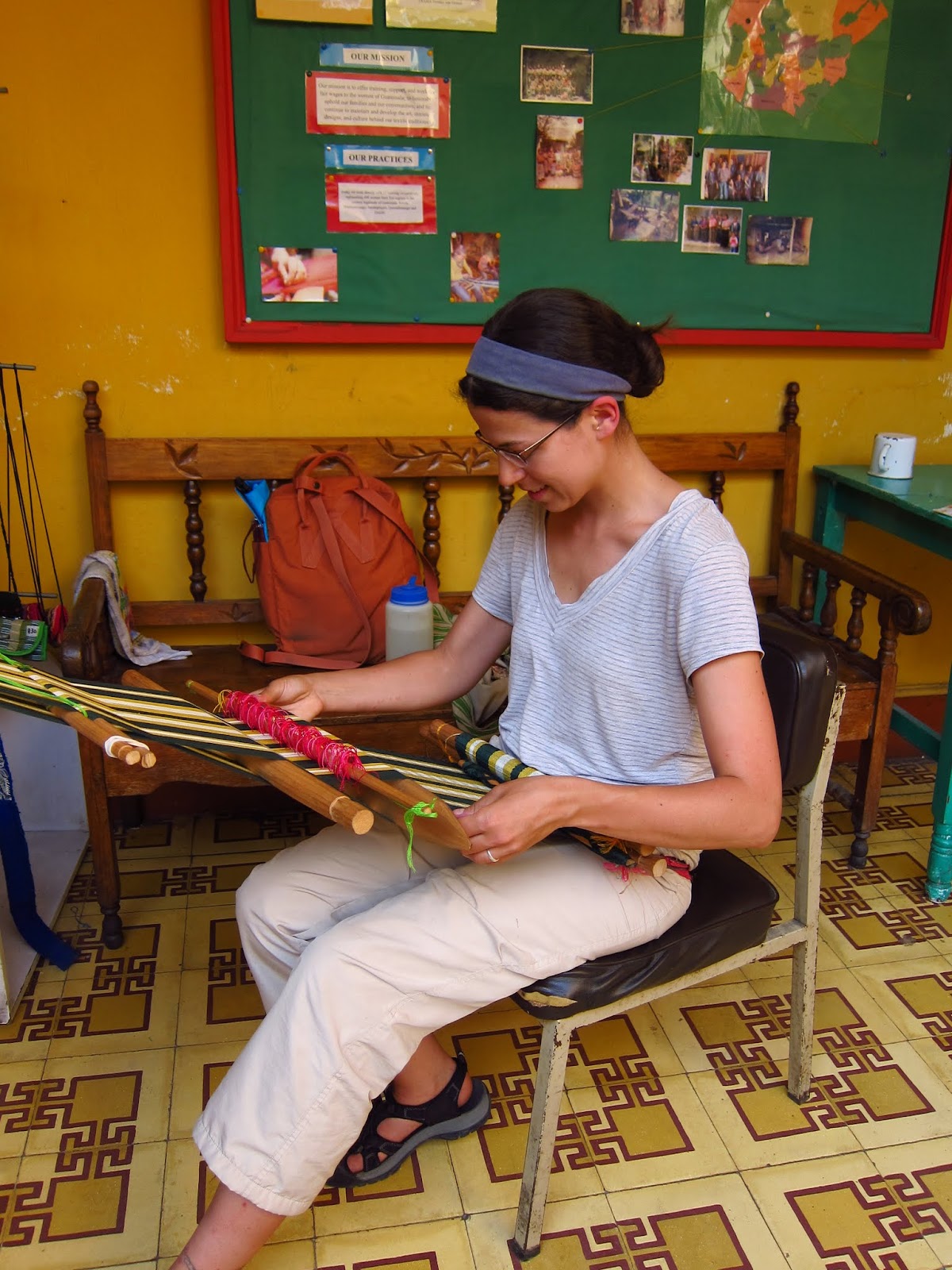
Step 7: Weave! ¡Teja! Weaving is divided into two processes, proceso uno and proceso dos.

Proceso uno:
Lift the laviadura, raising one half of the threads.

Insert the torpidor, an oblong piece of wood, under this half of the threads.

Pack down the threads already woven.

Rotate the torpidor, raising this half of the threads.

Pass the trama, a baton with thread wrapped around it, under this half of the threads. The thread on the baton becomes the weave threads (in contrast to the warp threads, which go lengthwise along the scarf).

Remove the torpidor.

Proceso dos
Slide together the laviadura and the pulito. This raises up the other half of the threads! Neat!

Insert the torpidor under the other half of the threads.

With the torpidor, pack down the thread that you just placed with the trama in proceso uno.

Rotate the torpidor to lift the other half of the threads.

Pass the trama under the other half of the threads.

Remove the torpidor. Start from the beginning of proceso uno again, using the laviadura to lift the first half of the threads!

If that didn't make any sense, here's what the sequence looks like when you put it all together:


Step 8: When you reach the end of the warp threads, cut the piece from the dowels and tie the lose ends in decorative knots.

All done!

Thursday, December 9, 2010

Father Abraham (In a Purple Headscarf?)

After Mr. Turkish Bull got our stupid, foreign asses onto the right bus, we found ourselves in the middle of Şanlıurfa. On a whim, I dragged Dave into a bookstore, where I scored a pocket Turkish/ English dictionary for 3 lira.

This came in handy, as shortly thereafter we were mobbed by a dozen young boys who would be our friends for the afternoon. Twelve-year old Mahmut somehow had a Turkish/ English phrasebook with him, so we swapped phrases such as, "I hope you have a safe journey" and "How many children do you have?"

little mahmut in the white shirt next to dave
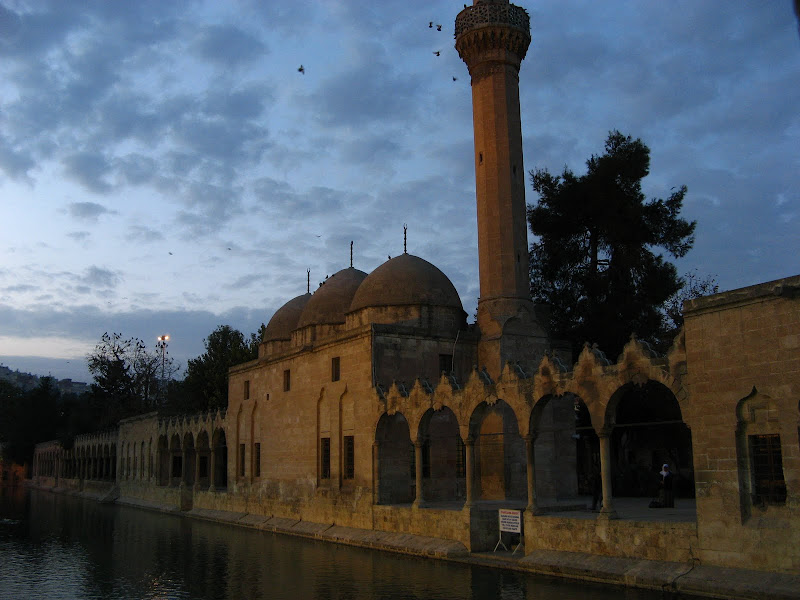
The boys decided to take us to "Fish Lake." As the legend goes, King Nimrod got really pissed off at Abraham and threw him into a fire. God/ Allah was all like, "Oh no you don't," and He turned the flames into water and the coals into carp. The fish in this pond are huge, glossy, and very excited to eat the pellet food sold by vendors in the park.

"fish lake" at dusk
The next day, we made a pilgrimage to the cave where Prophet Ibrahim/ Patriarch Abraham supposedly was born. The sign next to the door noted the segregated sides for men and women and requested that women to wear long skirts and headscarves (and to refrain from taking photos during prayer). Fortunately, I happened to wear my long skirt and to have a scarf in my bag.

entrance to ibrahim's/ abraham's cave
I don't think I would have taken any pictures, anyway. The mood inside the cave is pretty intense. Women swathed in the purple headscarves typical of Şanlıurfa sat on carpet squares in tight rows, either praying or sitting quietly. One woman was reading a beautiful Arabic Quran. Some women were filling up cups or bottles with holy water from a spigot. A little boy ran around, occasionally shrieking. One woman was crying.

It blew my mind to think that Abraham was born here, oh, plus or minus 4,000 years ago. And this city has been continuously inhabited for nearly 6,000 years! Even the historical Buddha was born "only" 2,500 years ago. Such history! And how lucky I am to have visited so many sacred places this year. Too bad Christians, Muslims, and Jews seem to forget that they are all children of Abraham...

urfa's citadel
After visiting Abraham's cave, we climbed to the top of the Şanlıurfa kale, or citadel, to enjoy the great views of the city. Highly recommended, it was a lovely little walk.

other tourists at the top
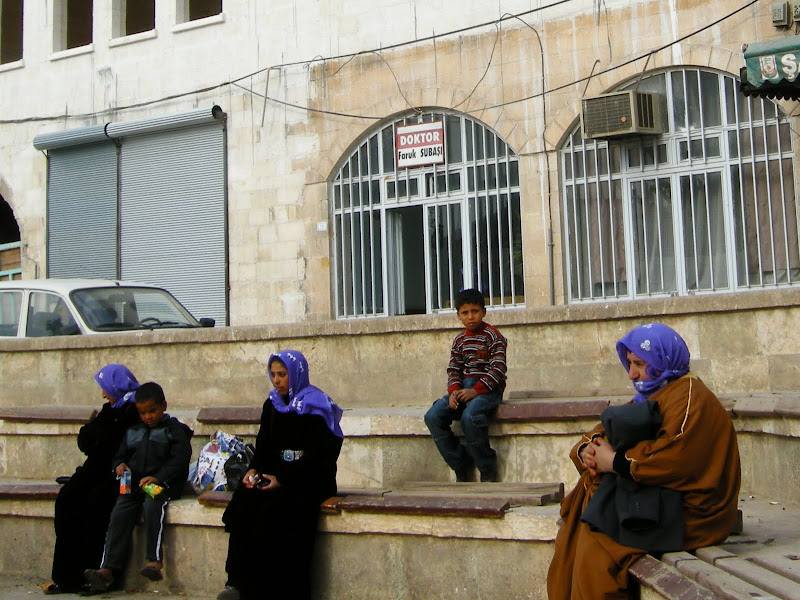
Şanlıurfa fashion is... distinctive. Many women wear traditional clothing: a velvet, floor length dress with a leather belt, a velvet cloak, and then another light brown cape. It reminds me of medieval dress. Both men and women wear purple headscarves, apparently all the rage this year. But there are also many women who wear trendy long skirts and snazzy, urbane long jackets.  This is Turkey: part West, part East, part modern, part traditional.

women in typical urfa dress
How could I resist? My lone Turkey souvenir is a trendy purple Urfa headscarf.

this picture destroys any chance at holding public office in the united states.
(i'm not sure i'm disappointed.)
but isn't it a pretty color?
Did Father Abraham wear a purple scarf?  I guess we'll never know...

Wednesday, December 8, 2010

Diyarbakir, My Heart (Or: How To Communicate Without a Shared Language)

We flew from Kathmandu to Sharjah in the United Arab Emirates.  The only thing I'll remember about the UAE is that drinking water is not freely available in the airport--guess that's what happens in the desert?  The flight from Sharjah to Istanbul didn't arrive until midnight, so in typical Davo and Nico style, we slept on the cold marble floor of Istanbul's Sabiha Gökçen Airport.  The following afternoon, we flew to Diyarbakir, a predominantly Kurdish city in southeastern Turkey.


Why Diyarbakir?  Why not.  ;-)

Ok, I'll stop being cheeky.  :-P  The well-worn grooves in the Asian backpacker tourist trail left me disillusioned with the potential for meaningful travel experiences.  I wanted to get a little farther off the beaten path.  Most tourists to Turkey stick to the western half of the country, but everything I've read highly recommends a visit to the eastern half.

Sold.

It was clear that we were the only foreigners on the flight to Diyarbakir.  Diyarbakir's airport terminal is smaller than Ithaca's.  All signs were in Turkish.  We said, "Otobüs" to some men in uniforms.  It worked!  The pointed us outside.  The bus driver knew only one English word:  "Yes."  Well, I guess it's time for adventure!

We were dropped off at some place near the old city.  I'm used to locals staring openly at me, and we sure drew some attention.  Within five minutes, a group of children had noticed our big backpacks and circled us like puppies wanting playtime.  A young woman shook Dave's hand vigorously and kissed my cheeks multiple times.  This was the pattern for the next few days:  someone talks to us loudly and slowly in Turkish, repeating the words again and again, as if that would help me magically understand (it's hilarious!!).

ercan, ugur, and another guy whose name i forget
Ten minutes later, three non-English speaking students befriended us and appointed themselves our unofficial tour guides for the evening.  Together, we toured the "mean streets" of Diyarbakir.  Diyarbakir had/has a bit of a bad reputation due to local activity by the PKK (Kurdistan Workers' Party), a terrorist organization according to the USA and the UN.  This is a poor city by Turkish standards, and my impression is that many Turks from the west find it backward, provincial, and conservative.  Young people frequently told me that they had 7 or 8 siblings.  A surprising number of men sit in teahouses in the middle of the day--unemployment is high.

We visited the city walls, the central bazar, and the Ulu Mosque, and we drank tea together.  The students identified themselves as Kurds, not Turks, and were very proud to teach us Kurdish words and to drink Kurdish tea.  Kurdish pride is everywhere and constant.  When the man selling me a bus ticket randomly indicated that Diyarbakir was Kurdish, not Turkish, I said "roj bash" ("hello" in Kurdish) to him, and I thought he would die of happiness on the spot.
woman wearing the white headscarf typical of diyarbakir

muhammed and sabra
As we were walking to our couchsurf host's apartment, a man stopped us to invite us to dinner at his home.  Muhammed, who is studying to be an imam (Islamic leader), lives with his mother and his sister.  We learned that his family is Zaza, which is related to but not the same as Kurdish.  His mother made an amazing vegetable dish of eggplant and tomato, served with bread and rice, with a drink of ayran (a watery yoghurt).  It was delicious!  When she saw Dave's bare feet, she insisted on giving him a pair of socks.  I liked her a lot, and I think she liked me, as well.

We spent this entire evening in the company of new friends who know maybe a dozen English words between them.  A shared language is not necessary for communication, nor is it necessary for a good time.  With the university students, we pantomimed our sentences like a three-hour game of charades.  Better entertainment than communication, but guaranteed to provide plenty of laughs!  At Muhammed's house, we used Google Translate to "talk" back-and-forth.  The translations aren't always perfect, but it's possible to talk about more than "I like ___" and "This is called ___ in my language."

on top of the city walls
The next day, we wandered around the old city again.  My journal lists twelve separate awesome interactions with Diyarbakir citizens, from someone who wanted to practice English with us to multiple invitations for tea.  The old itself has a medieval feel, a twisting maze of tiny streets flanked by ancient taupe buildings.  I had the best meal since New Zealand--some sort of cold eggplant dish with rice, fresh bread, and multiple salads.  Pomegranates, olives, and cheeses are sold on the street.  We climbed up onto the city walls and watched the sun set over the city.  There is nothing to interest tourists here, and that is precisely why I love Diyarbakir.


the courtyard of a centuries-old hotel,
back when europe was in the dark ages and the muslim world was the light of civilization
I couldn't take enough pictures to truly express our experiences, but here's a start:

Friday, September 24, 2010

8 Things I Love About Cambodia

Women love to wear coordinated pajama sets during the day.  I haven't quite figured that one out, yet.


There are itty bitty Cambodia kitties everywhere, and they're all friendly.


I love biking everywhere.  And it's not just tourists--Cambodians bike, too.  Although they put multiple people on a bicycle, on the theory that:  (number of wheels) x 2.5 = maximum capacity of vehicle.


Calves are ridiculous looking and induce smiling.  Water buffalo are funny, too.


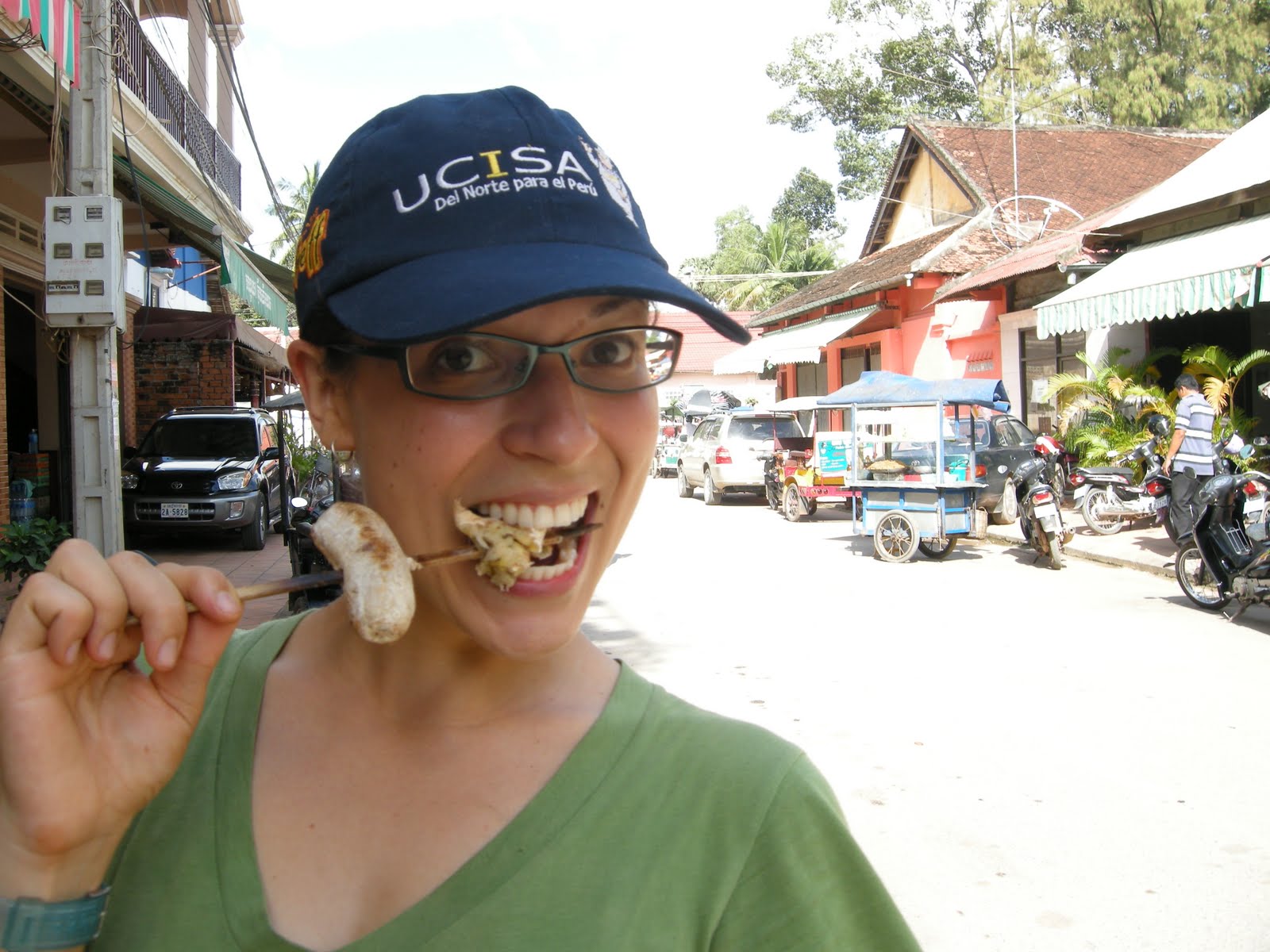
Bananas on a stick.  I rest my case.


Cambodian food rocks.  More on that here.


We've been here 10 or 11 days, mostly going about the business of life...  sleeping, eating, thinking, wandering.  Not a lot of sightseeing or vacation type activities.  Just living.  And in the process of everyday life, we got to know a few people.  It's reassuring and pleasant to recognize the same face every day.  We've eaten pretty much every meal in one of two restaurants.

Breakfast and lunch at Navy Kitchen:

Dinner at Five Sons:

And last, but certainly not least, is my friend that I greet every evening:


"Fat Frog," or as I like to say, "FAT FROG!!!" hangs out on the first floor of my guesthouse.  He stands next to a column of ants and snatches one after another, hoovering up the entire colony.  He's actually not that fat, but when he sees me, he puffs up.  Haha, I'm giggling just looking at his picture.

This are the little things that make me feel at home.  Silly routines, recognizing faces, noticing little details...  life on the road is just like life at home.  Same same...  but different.

Monday, August 23, 2010

Yankee Girl in Muslim SE Asia

On Friday, I crossed the Malay-Thai border overland, ending two months of travel in predominantly Muslim Southeast Asia (Indonesia and Malaysia).

While the wars in Iraq and Afghanistan grind on, America is having a crisis of conscience and Constitution over the proposed mosque at Ground Zero. Muslim culture couldn't be more alien, frightening, or distasteful to a large percentage of Americans.

I said I would consider writing again if I had something interesting or meaningful to say. In this rather lengthy post, I'd like to share some of my thoughts and experiences as a Westerner in a Muslim culture. There is no substitute for getting on an airplane to live it yourself, but if you can't, the next best thing is hearing about it from someone who did.

From Ramadan McDonald's to my first copy of the Quran, this is a Yankee girl's experience of Islam in Southeast Asian.