Pages

Showing posts with label cambodia. Show all posts

Thursday, January 6, 2011

Ithaca Has Given Me the Beautiful Voyage

I met a Columbian in Cambodia.

A jovial man, the type of man who ends up in the middle of everything, he was convincing people on the street to eat at the restaurant where he sat.  Why?  Why not.  There was free popcorn, and this was amusing.

He found out that I was from Ithaca, not the Greek Ithaca.  He asked if I knew the famous poem about the place--the Greek Ithaca, that is.  I did not.

He sent it to me later that week.  Now I carry a copy with me always, in my mind.

I'm going back to Ithaca, my adopted hometown, though just for a visit.  I loved Ithaca--still do--but this isn't the time to drop my anchor in her port for very long.  I wonder what has changed since I left.  I know I have.  I'll go back someday, but that's not the point:  by the time I finally settle down, I don't think where I settle down will matter much.

Read this poem.  Read it slowly.  Enjoy it.  Remember it.  May your journey, not your destination, provide your riches.

Ithaca
Constantine P. Cavafy (1911)

When you set out on your journey to Ithaca,
pray that the road is long,
full of adventure, full of knowledge.
The Lestrygonians and the Cyclops,
the angry Poseidon -- do not fear them:
You will never find such as these on your path,
if your thoughts remain lofty, if a fine
emotion touches your spirit and your body.
The Lestrygonians and the Cyclops,
the fierce Poseidon you will never encounter,
if you do not already carry them within your soul,
if your soul does not set them up before you.

Pray that the road is long.
That the summer mornings are many, when,
with such pleasure, with such joy
you will enter ports seen for the first time;
stop at Phoenician markets,
and purchase fine merchandise, mother-of-pearl and coral, amber and ebony,
and sensual perfumes of all kinds, as many sensual perfumes as you can;
visit many Egyptian cities,
to learn and learn from scholars.

Always keep Ithaca in your mind.
To arrive there is your ultimate goal.
But do not hurry the voyage at all.
It is better to let it last for many years;
and to anchor at the island when you are old,
rich with all you have gained on the way,
not expecting that Ithaca will offer you riches.

Ithaca has given you the beautiful voyage.
Without her you would have never set out on the road.
She has nothing more to give you.

And if you find her poor, Ithaca has not deceived you.
Wise as you have become, with so much experience,
you must already have understood what Ithaca means.

Friday, September 24, 2010

Khmer Kitchen

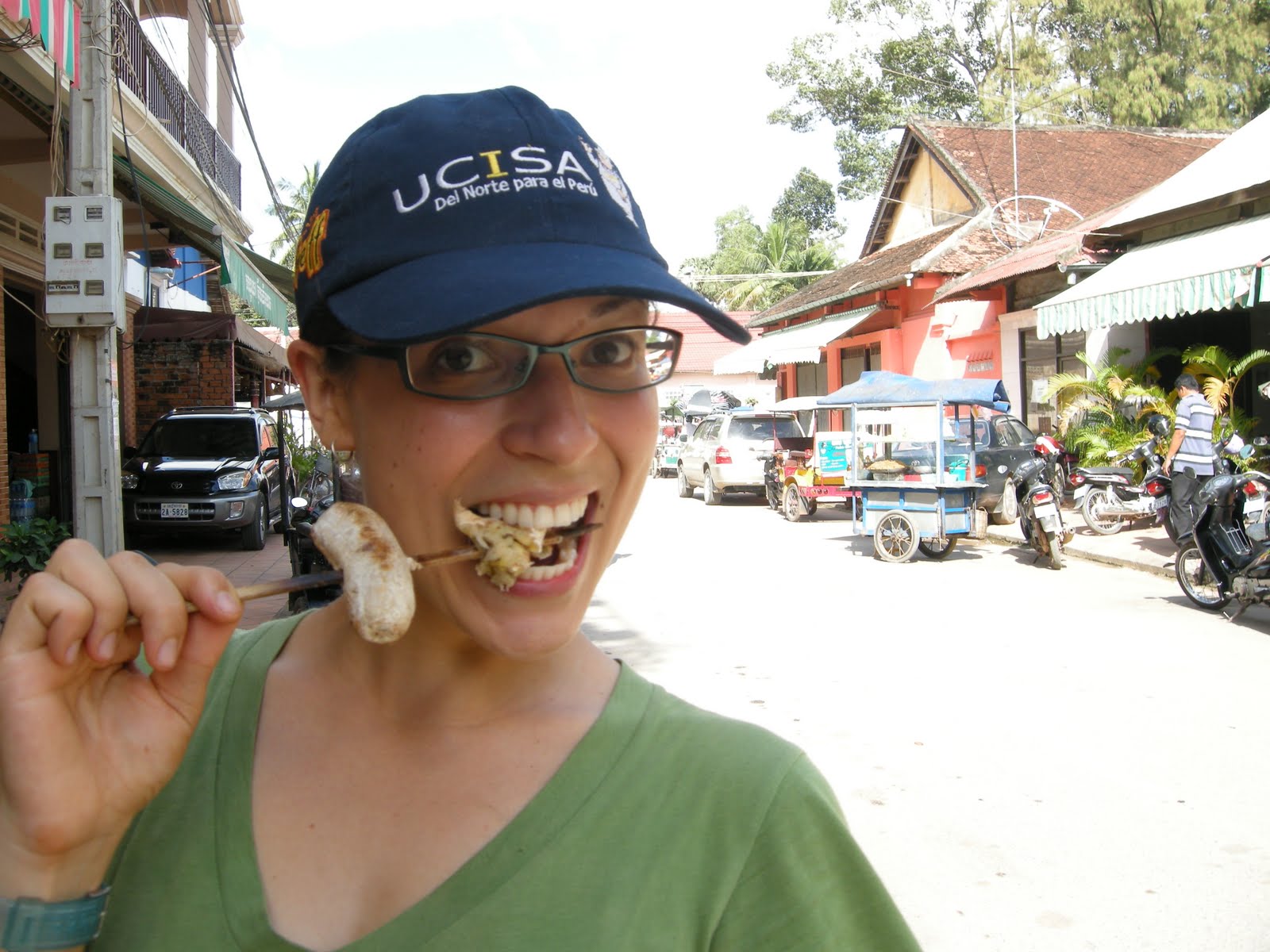
Cambodian, or Khmer, cooking might not be as famous as its cousin to the west (Thai), but I like it even more.

The staple food is white rice, which is eaten at every meal (and which I hate).  But there are many influences from abroad that blend together with a dash of Cambodian ingenuity into a fusion that's quite pleasing to the Western palate.  From Cambodian's French colonial past, you'll find baguettes and strong coffee for breakfast.  From Cambodia's cultural inheritance from India, you'll find delicious mild curries (kari).  And there are plenty of noodle dishes and soups, due to Cambodia's links with China.

Khmer specific dishes include amok, made with thin strips of leafy greens, and samlor ktiss, a coconut curry soup.  I like that chilis seem to be served on the side, so you can make the dish as hot as you want.  The Khmer cooks I've chatted with seem to take a very loose, creative approach to their cooking.  If they want to make their amok more like a curry, well, that's what they do.  If they want to serve something with a creative sauce, it's on the menu.  And this is in the restaurants where meals go for $1-3 dollars.  Definitely not the standard fried noodles/ fried rice.  Pretty neat.

We've been eating breakfast and lunch at Navy Kitchen, where a huge entree plus free rice, tea, and pineapple slices will set you back a whopping USD$2.  It's located on this block (sorry, no street name or address, that's not a common thing in this town).  Eat here.  You'll thank me.


View Larger Map

Davo and I asked if "Ma" ever gave cooking lessons. Her surly but sweet 21 year old son, Bati, said sure. I inquired about a price, and he said, "Whatever you think." Gotta love informality.

So one afternoon, she let us into her cramped kitchen.  The kitchen itself was about as dirty as you'd expect, but everything that touched food was surprisingly clean.  And did I mention that the kitchen was tiny?  With two tiny Cambodians and two enormous Westerners, we were tripping over each other.  Ma is fast in the kitchen, and we were always in the way.

 
Also, I need a lesson in the proper way to stir soup.


It was a fun little demonstration.  Ma deemed my effort at hot and sour soup "eh."   But I was proud.


Cambodian Hot & Sour Soup


Ingredients:
  • ~1.5 cup water
  • ~1/2 boullion cube
  • 1 clove garlic, smashed
  • 1 in. piece of galangal, smashed
  • a few small pieces of ginger, julienned
  • handful of onion pieces
  • handful of carrot pieces
  • handful of tomato pieces
  • handful of pineapple pieces
  • handful of shredded dark leafy green
  • juice of 2 keffir limes
  • 1 egg
  • big spoon of sugar
  • salt, to taste
  • chili, if you want
  • tamarind paste, as much as you want
  • as a garnish, minced garlic fried in oil until brown
Method:

In a little pan, heat up the water to a boil with the boullion, garlic, ginger, and galangal.  Add onion and carrot, cook for a minute.  Add tomato, pineapple, leafy greens, stir for a minute.  Add juice of limes, egg, sugar, salt, tamarind paste, and chili.  Cook for a few more minutes.  Add the garlic as a garnish.  Simple!

Finding Mind Happiness in Siem Reap

I came to Siem Reap to avoid Bangkok and to see Angkor Archaeological Park, which can be done in a day or two. Somehow, I ended up staying close to two weeks.  Those nice plans to get into northern Thailand, where there's hiking and hills, went right out the window.  Oh well.  I like this corner of Cambodia.

Impressions of Siem Reap...  well, a few decades ago, the insane dictator Pol Pot was extremely effective in eliminating a large chunk of the population, something like a third of the population, including anyone literate.  The country has only been stable for the last twenty years.  Tourism is new--maybe ten years.  Perhaps due to this, there is noticeable desire here to have a good, stable life, and it's much stronger and more easily acknowledged here than anywhere else I've traveled.

At least two Cambodians have mentioned that they have problems sleeping at night due to the stress of their business, making money, providing for their families, and worrying about the future.  And this comes up in small talk!

The entire young generation desperately wants to learn English.  English proficiency is seen as an absolute prerequisite for securing a job, at least in the Siem Reap area.

One day, Dave and I wandered into a random temple compound outside the main tourist district.  A young monk waved us over, sat us down, and proceeded to spend the next 45 minutes talking to us about a project he's starting.  As a monk in the service of the community, Chea Yorn teaches English six days a week in both Siem Reap and the countryside.  Amazingly, he manages to do this with only an intermediate grasp of the language himself!  In his opinion, English is so crucial to the success of the youth in Cambodia that they simply must learn it, even if he has to teach every damn teenager himself.

In addition, Chea has hatched a plan to bring more income into rural areas by selecting two families to participate in a fruit and vegetable growing project.  Outside the rainy season, these rice-growing villages have no source of income.  If a few families could be taught how to grow fruits and vegetables, they could have income all year round, plus show other families these techniques.  The fruit trees could provide shade and fresh air in the hot, dusty villages.  He also has ideas for irrigation improvements.

Dave and I have visited Chea's evening classes a few times to help model native English pronunciations.  We're not in Siem Reap long enough to take over teaching any classes, but it seems our attendance and participation keeps the students engaged.  Every little bit helps, or so I tell myself.  I've noticed that other random people show up to watch the spectacle, so at least we're entertaining someone!  This temple isn't in the nicest part of town, but Dave and I walk back to our village after dark, and we feel safer walking out of the temple here than we'd feel in many parts of the United States.

The classes take place under the deck of the small building where Chea lives with three other monks and a few temple boys.  There's a dirty whiteboard, one marker, and a bunch of young Cambodians, ages 16 to 25.  One young woman adds the consonant "ssss" to the end of every word, which I find endearing.

Besides teaching English with only an intermediate grasp of the language himself, and hatching mad awesome plans to save Cambodia one family at a time, Chea gets up at 4 a.m, eats one meal a day, and participates in temple life as a monk.  He's 28 and has been a monk since age 15. 

But he's still part of this world.  An Australian gave him a laptop and a digital camera.  He's very quick to show off pictures of his students.  And, like everyone in my generation, he's on Facebook.

He was thinking of going to university, if he could get the money, or maybe just getting a job.  In this part of the world, it's common to become a monk for a few years in the teens or 20s to further education and to become a better member of society.  But maybe Chea will remain a monk.

In his words, "helping other people and we don't need to get anything back that is mind happiness. doing any good deed for each others it will make our mind peaceful. making our mind pure."

You said it, Chea.  This is 21st century Buddhism, and the answer to the questions of the retreat experience.

8 Things I Love About Cambodia

Women love to wear coordinated pajama sets during the day.  I haven't quite figured that one out, yet.


There are itty bitty Cambodia kitties everywhere, and they're all friendly.


I love biking everywhere.  And it's not just tourists--Cambodians bike, too.  Although they put multiple people on a bicycle, on the theory that:  (number of wheels) x 2.5 = maximum capacity of vehicle.


Calves are ridiculous looking and induce smiling.  Water buffalo are funny, too.


Bananas on a stick.  I rest my case.


Cambodian food rocks.  More on that here.


We've been here 10 or 11 days, mostly going about the business of life...  sleeping, eating, thinking, wandering.  Not a lot of sightseeing or vacation type activities.  Just living.  And in the process of everyday life, we got to know a few people.  It's reassuring and pleasant to recognize the same face every day.  We've eaten pretty much every meal in one of two restaurants.

Breakfast and lunch at Navy Kitchen:

Dinner at Five Sons:

And last, but certainly not least, is my friend that I greet every evening:


"Fat Frog," or as I like to say, "FAT FROG!!!" hangs out on the first floor of my guesthouse.  He stands next to a column of ants and snatches one after another, hoovering up the entire colony.  He's actually not that fat, but when he sees me, he puffs up.  Haha, I'm giggling just looking at his picture.

This are the little things that make me feel at home.  Silly routines, recognizing faces, noticing little details...  life on the road is just like life at home.  Same same...  but different.

Monday, September 20, 2010

Angkor Wat: The Macchu Picchu of Southeast Asia

A lifetime ago, when a copious supply of toilet paper was available in every bathroom and I didn't eat rice three times a day, i.e. when I was living in the United States and thinking about traveling, I assumed I would visit Angkor Wat in Cambodia.  I knew barely anything about Cambodia, only a little about the country's turbulent political history, nothing about the language or the cuisine, but I sure knew about Angkor Wat.  Everyone knows about Angkor Wat!  Even teenage boys--yeah, that's where Lara Croft did something-or-other in the Tomb Raider movies.  Angkor Wat is the Grand Canyon of the United States...  the Macchu Picchu of South America...  the Great Egyptian Pyramids of the African continent.

And here I am:
whoot!

Hands down, my favorite parts of the park have been as much natural as manmade.  This is a tree-lovers paradise!  Various species of tree have grown on top of, into, and around various ruins.  The shapes are stunning:  a juxtaposition of man's straight lines with nature's curves.


As I wandered around, I reflected on impermanence.  When these monuments were created, they were so solid.  At the time, it must have seemed like the construction would last forever.  Even now, the ruins have an eternal feeling to them.  But everything that is built will eventually crumble.  Maybe not tomorrow, maybe not this millenium, but eventually it will change and fade away.  That's just the law of nature.


Speaking of nature, I also sensed how everything that arises from nature goes back to nature.  Humans borrowed these stones and piled them up.  Now, nature is taking back what was always hers.


On a less dreamy note, the problem with everyone knowing about Angkor Archaeological Park is, well, everyone knows about it!  After the jump, a little rant about mass tourism and a few suggestions for future visitors...