Pages

Thursday, April 29, 2010

Let's Talk About Flax

Let's talk about flax.  This summer, we harvested and transplanted approximately 600 flax plants into the valley where we work.  What is flax, and why do we spend so much time working with it?

New Zealand flax is actually a member of the lily family (although parts of the plant can be used for making fiber, like European flax).  Flax has extremely long, sword-shaped, stiff leaves.  These leaves grow in a fan shape, and one plant growing from one root system can send out 8, 12, or even more fans.

This is New Zealand flax, complete with flower stalks with seeds.

In the spring, the flowers of the flax are an important source of nectar for birds, as they are too deep for bees.  In fact, the flowers of the flax plant curve at the same angle as the beaks of the tui birds!  In the summer, the flax sets its seeds, which are also an important food source for birds.  It's also a great shelter for birds, snails, and other insects.  (Remember, NZ does not have native land mammals, so birds are an extremely important part of the ecosystem here.)  Flax roots do a great job of penetrating very hard soils full of clay; their roots also do a great job stabilizing erosion-prone soil.

Flax has been used for many purposes by traditional Maori society.  Known as harakeke in Maori, flax fiber has been used to make clothing, ropes, canoe lashings--even baby rattles!  Nearly every part of the flax plant also has medicinal uses.  The leaves and flower stalks are used to stabilize and treat broken bones and other wounds.  A juice made from flax root is also a great disinfectant.

In this little video, Dave talks about flax and why it's important in New Zealand ecology.


Harvesting flax is a very dirty, very tiring job.  We work in pairs; one person uses a spade to dig around the fan of flax leaves and to separate the roots of the fan from the rest of the plant, while the other person grasps the fan by the outer leaves and tugs and pulls until it comes free.  We aim to harvest 200 plants every time we go into the field; this week, it took us only 2.5 hours to gather 181 plants (practice does help!).

If we're not going to replant immediately, we dump the flax in the river so it doesn't dry out.  Then we have to pull all of it out of the river and throw it back on the trailer.  (We usually make Dave do that part.)  Planting is simple--yank out the grass, dig a hole, pop in a plant, tap down the soil, use the grass as mulch around the bare soil.  Planting in wetlands is muddy and sloppy; once you get past the dirtiness, it's actually fun.

Here's a series of portraits from our last time harvesting flax:


...complete with lucky spade!  Yeah, we're having fun!

To get the flax from the bush to the trailer, we set up a fire line and toss each plant from person to person:


Unfortunately, I don't have any pictures from planting.  Imagine a spade and lots of dirt and you'll get the picture.

Yeah flax!

Wednesday, April 28, 2010

River of Ice


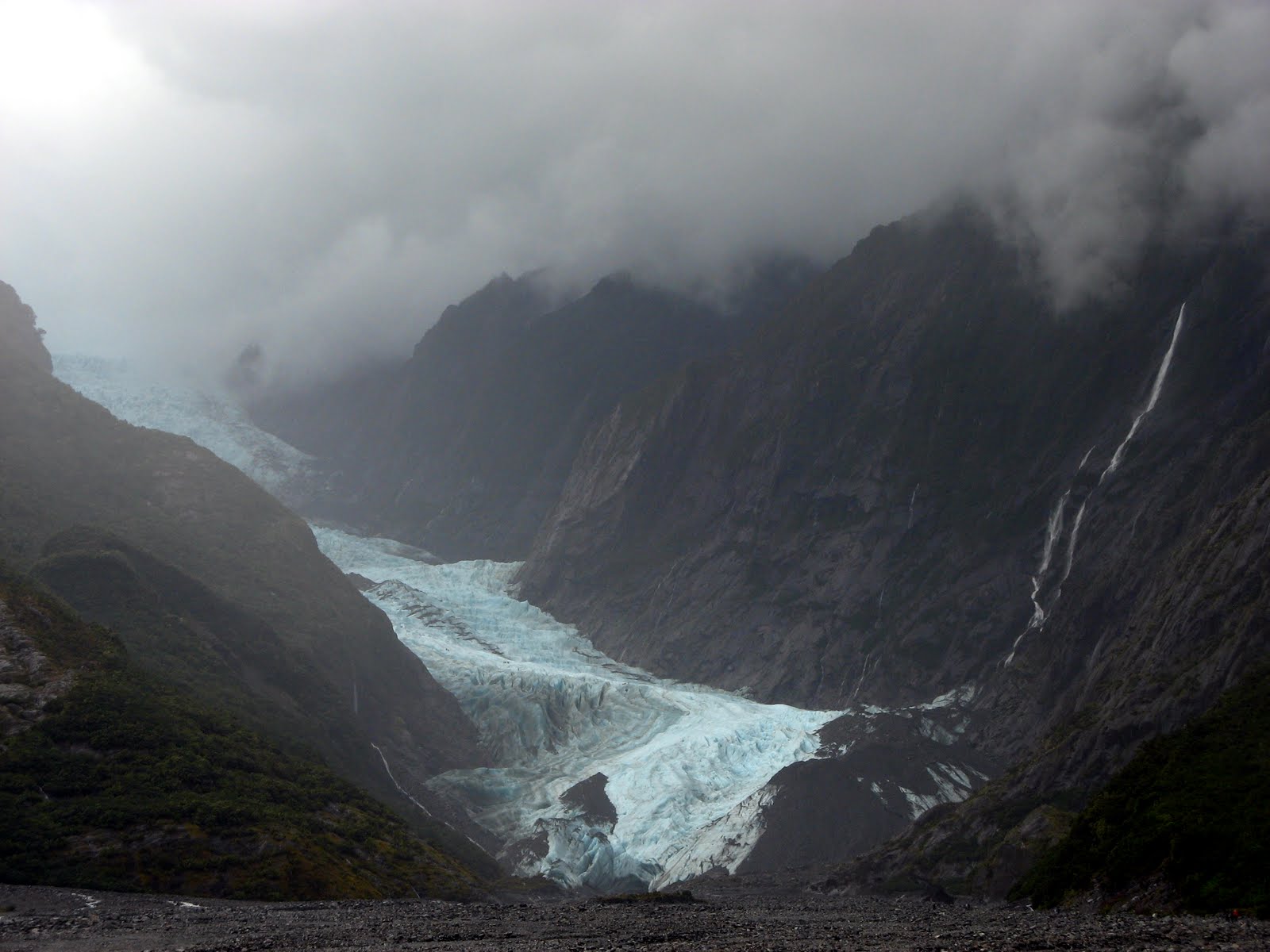
On our way down the west coast of the South Island, Dave and I stopped at the Franz Josef and Fox Glaciers.  Our hiking plans were completely thwarted by the torrential rains that had hit the area just a few days before our arrival.

That's a lot of water going under that bridge...

We did manage a quick walk up the glacial valley to the Franz Josef Glacier.

Waterfalls to rival Ithaca's cascade down the walls of the valley

Glaciers are rivers of ice...  literally.  Meters upon meters of snow will fall on the top of a steep mountain.  The weight of the constant snowfall compresses itself into sheets of ice.  The weight of the denser ice then slowly starts to slip down the mountain.  As the ice moves, it carves out grooves in the side of the mountain.  Viola!  A glacier and a glacial valley!

The massive Franz Josef glacier

Glaciers advance and retreat, meaning they move forward, away from their source (the “neve”), or backward, toward their source.  When the rate of glacier creation—snowfall in the neve—is greater than the rate that the glaciers are melting and breaking apart at their terminus, then the glacier advances.  Most glaciers around the world are retreating, but the glaciers on the west coast of the South Island are advancing.

water in three phases:  cloud, river, ice

The Franz Josef and Fox glaciers are unique because they travel from the highest mountains in the country—over 3,000 meters—to the coastal rainforest in a span of only a few kilometers.  Dave and I slept next to a beach, but we visited the Franz Josef glacier before lunch.  These glaciers also move much faster than the average glacier.  A heavy snowfall in the neve will produce an advancing glacier in about five years.  The glacier can move up to a meter a day.

the only picture in which one or both of us is not sticking out a tongue, crossing eyes, or making goblin faces

So, that's all you ever wanted to know about glaciers.  Another spectacular phenomenon of our beautiful world!

Monday, April 26, 2010

Moving South...

From Taranaki, we headed south to Wellington, the capital city of New Zealand.  I'm not much for big cities, and neither is Dave, so we spent only one day in Wellington.  Most of our time was spent at Te Papa Tongarewa, the National Museum.  It's one of the best museums I've ever visited.  I really enjoyed the exhibits on the geology and natural history of New Zealand.

Here are some pictures from our time in Wellington and Te Papa:


After Wellington, we took the Bluebridge ferry across the Cook Straight.  The voyage was very "meh," but the two ferry companies try to make it sound more exciting than it actually is.  It was pretty expensive to bring the van across, but since it's our transportation and our home, it was worth it.  Here are some pictures from the Cook Straight:

Sunday, April 25, 2010

Taranaki: This Makes 3 Mountains in 5 Days

Back in New Plymouth at the library.  Two days ago, after sitting right here, we went to the North Egmont Visitors' Center, packed our bags, parked the van, and hiked in to the Maketawa Hut.  The New Zealand Department of Conservation maintains hundreds of backcountry huts, which are very convenient for hikers and trampers.  This was my first night in a DOC hut with my brand new, shiny backcountry hut pass.

thumbs up!  DOC hut!

At first, I wasn't sure if we'd get to climb Taranaki, due to the clouds covering the mountain.  But when we woke up in the morning, the summit was clear, so we decided to give it a try.

whoa...  that shit is STEEP

First the track takes you up a steep road to an alpine club hut.  Then it climbs through a little gorge to a series of stairs.  From the stairs, you drop out onto the scoria slopes (steep slopes covered in gravel and sand).  Last, you climb a steep, old lava flow nicknamed "The Lizard" in a long scramble to the top.  At the top, you cross an ice- and snow-covered crater to get to the true summit.  Except we didn't stand on the true summit, as it has religious significance for the Maori.

above the clouds :-)

After getting my butt handed to me by Ruapeho, I was so happy that this day went well.  The climb is steep and strenuous, but it's definitely "do-able" by mere mortals, like myself.  The hike rises 1.6 km--one vertical mile--in about 5 km (~3 miles).  I've now climbed the three major peaks on the North Island in the span of five days.

Here are the rest of the pictures from the day:


We're going to head toward Wellington later today, then on to the South Island and all of the wonderful hiking and tramping there!  I've written a few posts to automatically post over the next week or two, but maybe we'll find another public library soon.  Until then...  onwards and upwards!

Friday, April 23, 2010

Tongariro II: Who Goes To Mordor Twice?

At the moment, Dave and I are in New Plymouth, a lovely little city on the Pacific Coast near Egmont National Park and Mt. Taranaki.  We jumped into the public library to use the internet.  Here's a recap of the past few days...

About a month ago, I took an “epic” trip to Tongariro National Park with my Earthwise Valley friends (read about it here, here, here, and here).  We climbed Ngauruhoe, the conical volcano (~2200 m) that was the inspiration for Mr. Doom in Peter Jackson's the Lord of the Rings movie trilogy, and part of the group climbed Ruapeho (~2700 m).  I didn't get to climb Ruapeho, and Dave didn't get to go on the trip at all, so Tongariro was the first stop on our New Zealand road trip.


Day 1, Tuesday, 4/20:  We had left Tuateawa late the previous day, so we woke up early and finished the drive to Tongariro.  After prepping our packs, we hit the trail around 11 a.m.  We took our time and enjoyed the great weather as we passed Taranaki Falls and then the Tama Lakes.


We got to the same basecamp where I had camped four weeks previous in the late afternoon.  There was plenty of time to scout out a flat tent site, sheltered from the wind, to set up the tent and sort gear, to dig a latrine hole, and to put together dinner fixins'.


The sunset wasn't as spectacular as the first sunset the last time I was there, but it was still very pretty.  Since we had arrived at the campsite so early, we were in the tent only an hour after dark (7:30 p.m.).  We stayed up talking until about 9:30 p.m, until we were able to doze off.  It was a cold and windy night.


Day 2, Wednesday, 4/21:  Summit day!

Happy Birthday, Sisser!

Today, my sister Katie turns 22.  Happy birthday, sis!  How are you already 22?  Wasn't it just yesterday that...  well, let's not go there.  :-P  I hope you have a great day with your friends down in A.C.  Do everything I wouldn't do, and then some.  *wink*  I'm looking forward to the next time we get to skype in a few weeks.  Love you!


P.S.  The only recent/ decent picture of us I had the cat in it.  *sigh*  Appropriate.